
Our knowledge can only be finite, while our ignorance must necessarily be infinite.
— Karl R. Popper, “On the Sources of Knowledge and of Ignorance.” (1960)
Earthquakes cannot be deterministically predicted. This familiar limit of seismology is usually treated as a problem of forecasting: when, where, and how large will the next earthquake be? This project asks a slightly different question. What happens to uncertainty as earthquake knowledge is actually made, tested, organised, circulated, and acted upon?
Drawing principally on the C. P. Rajendran and Kusala Rajendran Papers at the Archives at NCBS, and centred on their work on the Andaman and Nicobar Islands, this public talk follows scientific knowledge across a longer life cycle than the conventional scientific method suggests. It moves from correspondence in which research problems are still possibilities, through proposals and progress reports, field observations, samples, laboratory measurements, dating uncertainties, interpretation, review, publication, and scientific training.
It then follows published knowledge as it travels beyond the immediate research programme: into government technical documents through citation, into disaster-management frameworks, and into newspapers, public explanations, and preparedness material. The surviving evidence supports these forms of circulation more strongly than a direct claim that the Rajendrans authored disaster-management policy.
Across these documents, uncertainty does not simply diminish as we progress along steps of the scientific method. It repeatedly appears to acquire a form suited to the work that must happen next: a possibility becomes a project; a landscape becomes a sample; and complex scientific reasoning can eventually become a pithy survival instruction.
By placing evidentiary documents beside one another, we notice visible transformations in epistemological form. We can thus hope to glean how uncertainty travels, and what must remain visible—and what is compressed or left behind—when scientific knowledge has to become usable.
Epigraph source: Popper, Karl R. “On the Sources of Knowledge and of Ignorance.” Proceedings of the British Academy 46 (1960): 39–71.
Speaker Bio:
Upasana Sarraju is a science writer, researcher, and author of Unruly: The Ig Nobel Prizes and the Science That Refuses to Behave (Penguin Random House India, 2026). This talk is based on her work as a research fellow at the Archives at NCBS between May and July 2026.
Parvathy:
Good morning, everyone. Thank you for being here in person and online. I'm Parvathy.
I'm part of the team at the Archives at NCBS. For those who are new here, I don't see anyone new, but for those who are new here, the Archives at NCBS is a public-connected center for history of science in contemporary India. At the heart of everything we do is a commitment to enabling diverse stories, and our research fellowship is also a part of this mission.
Our research fellowship program is designed to foster scholarship grounded in the historical connections preserved in the Archives. Today's talk is part of the program. We are grateful to the TNQ Foundation, whose generous support makes this program and the research emerging from it possible.
It is my pleasure to introduce Upasana, today's speaker, a science writer, a researcher, and the author of UNRULY: The Ig Nobel Prizes and The Science That Refuses To Behave. Her talk, titled The Scientist is Always Late: The Documentary Life of Uncertainty in Earthquake Science draws on her work as a research fellow at the Archives at NCBS between May and July 2026. Over to you, Upasana.
Upasana:
Hello. I’m Upasana.
Before I begin, I should probably say a little about why I ended up asking this question.
I've been interested in... [Audience member: Your mic is closed. Why don't you open it?] Are you able to hear me, sir? [Yeah.] Okay.
I have been interested in epistemology for a very long time — in fairly simple terms, in the question of how we know what we think we know. For this fellowship, I wanted to take that question somewhere concrete. Not simply: is a scientific claim true? But: what makes us justified in believing it?
Welcome to: The Scientist Is Always Late.
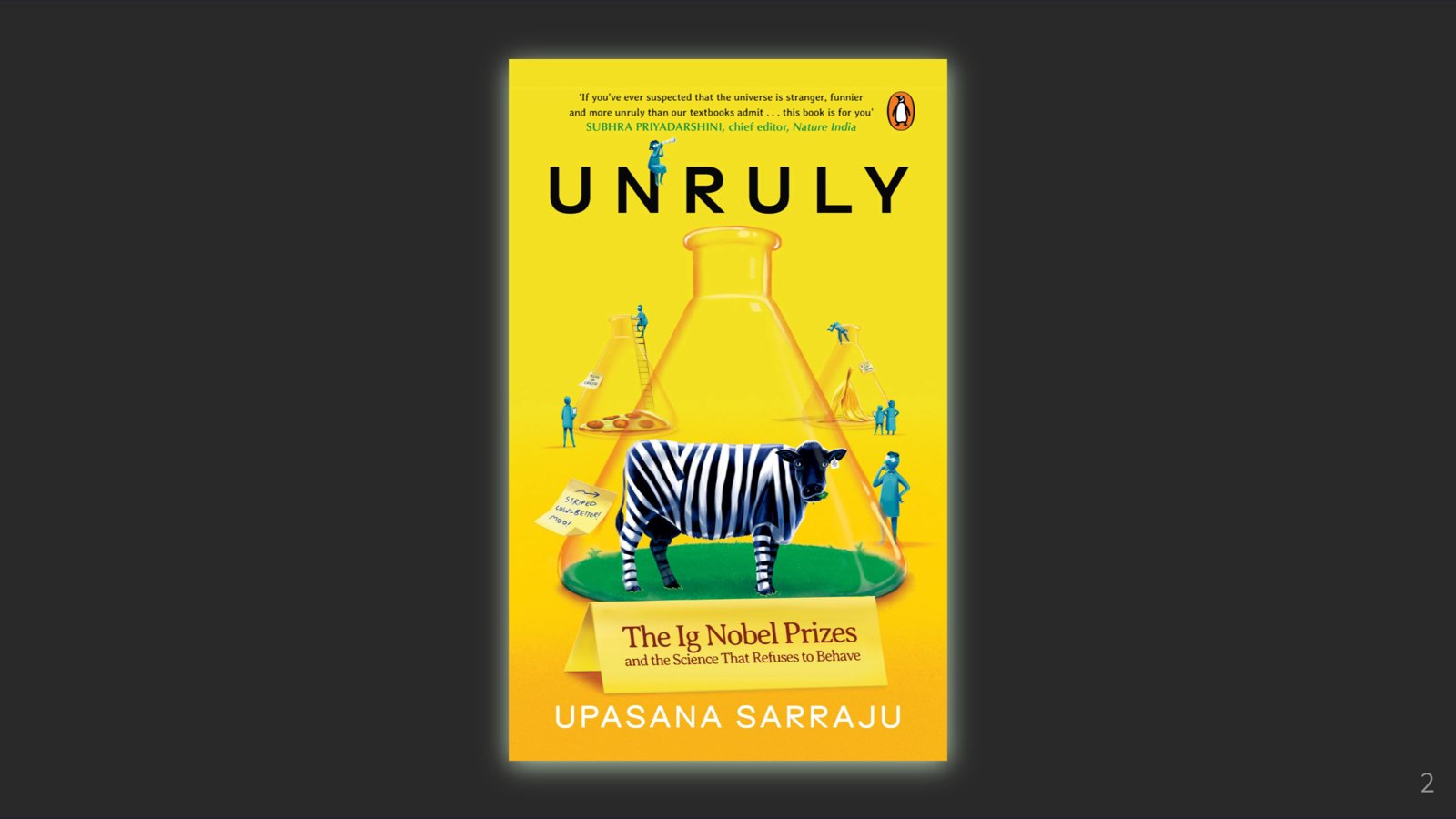
My previous work, for which I am now, currently world-famous, is a book about the Ig Nobel Prizes called Unruly. And that project was very much about perspectives towards science and interpretation. How scientific findings are perceived by different people, how scientific importance is judged, and how that judgment changes based on who is looking.
And because here I wanted to move closer to the fundamental nature of knowledge itself, of scientific ideas, we find ourselves here today talking about some papers from the Rajendran Collection of the NCBS Archives. So thank you very much for being here and to listen to some of these thoughts. I also hope that toward the end I'll get to hear some of your views on the ideas that come up here because I don't think these questions about epistemology, even if they sound very philosophical and vague, are only for scientists, writers and philosophers.
They are for anybody who has ever had to make a decision about which scientific knowledge to trust in order to make a decision.
So, when I say The Scientist is Always Late, I mean something fairly basic about knowledge itself. Very often by the time we know something scientifically, the thing we want to understand has already happened.
The natural event is gone, the organism has evolved, the past has completed existing and can't be revisited. Or the process that we are interested in may be happening in a place that we are not able to access directly. So the problem becomes relational.
What connects the evidence that is available to us to the phenomenon we are interested in? That link between evidence and a scientific claim or justifications for the claim is where I believe uncertainty lives. And from that uncertainty another question follows. How should our confidence change when that connection between evidence and claim is incomplete, indirect or open to more than one interpretation?
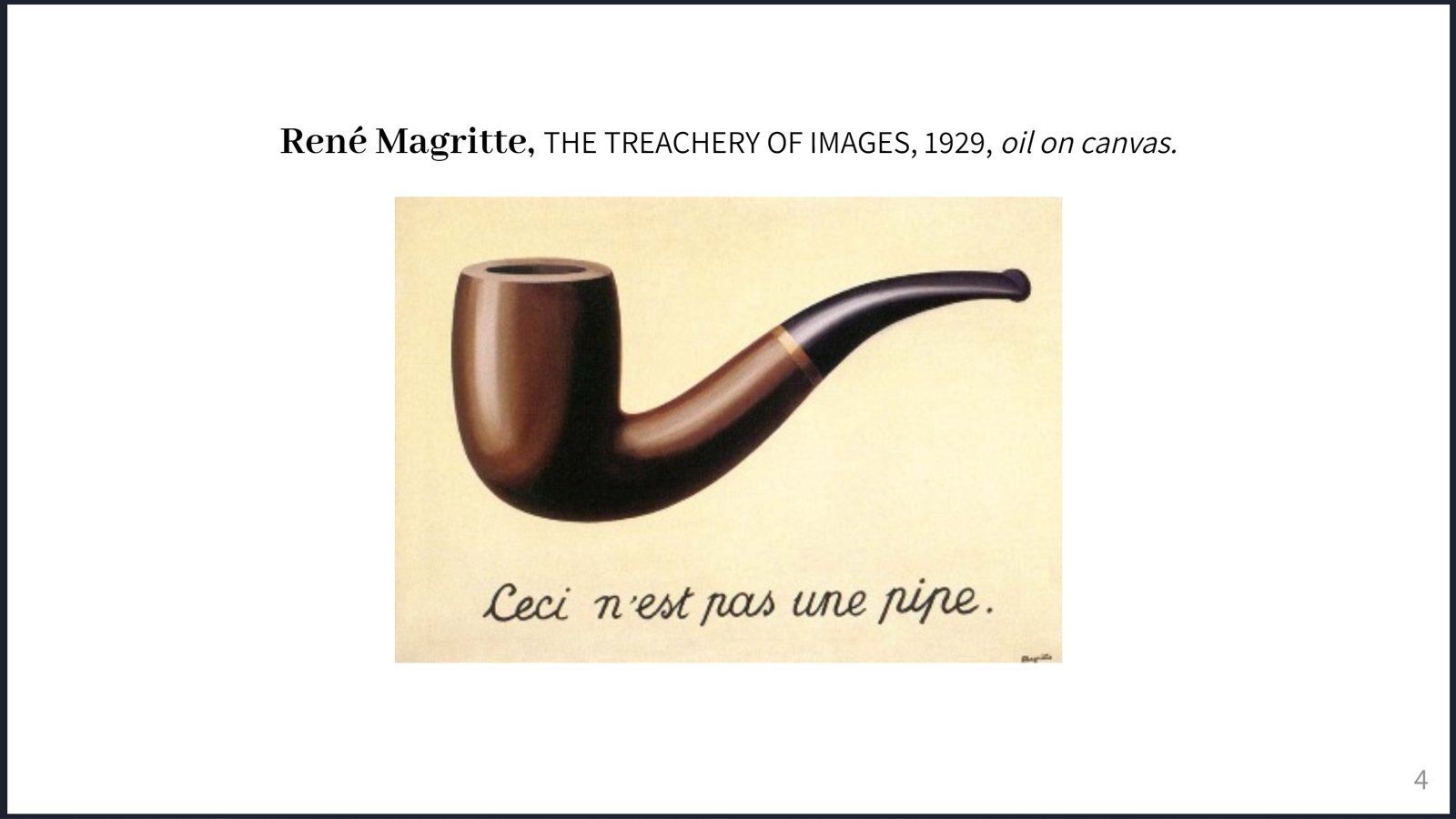
This is a famous painting by René Magritte called The Treachery of Images. And it's an oil painting of a smoking pipe. And underneath the image of the pipe he writes, in French, this is not a pipe. And of course, the artist is right.
You can't fill this pipe with tobacco, you can't smoke it. What you are looking at here is a representation of the idea of a pipe. But to us they don't seem that different from each other. A real pipe versus the representation of a pipe. And the distinction between both sounds very trivial and a little too philosophical. But it points towards something I kept encountering in science.
The object in front of the scientist is rarely the actual phenomenon that the scientist is trying to understand, because we work with representations of the phenomenon more than the phenomenon directly. And that is in no way peculiarly unique to earthquake science.
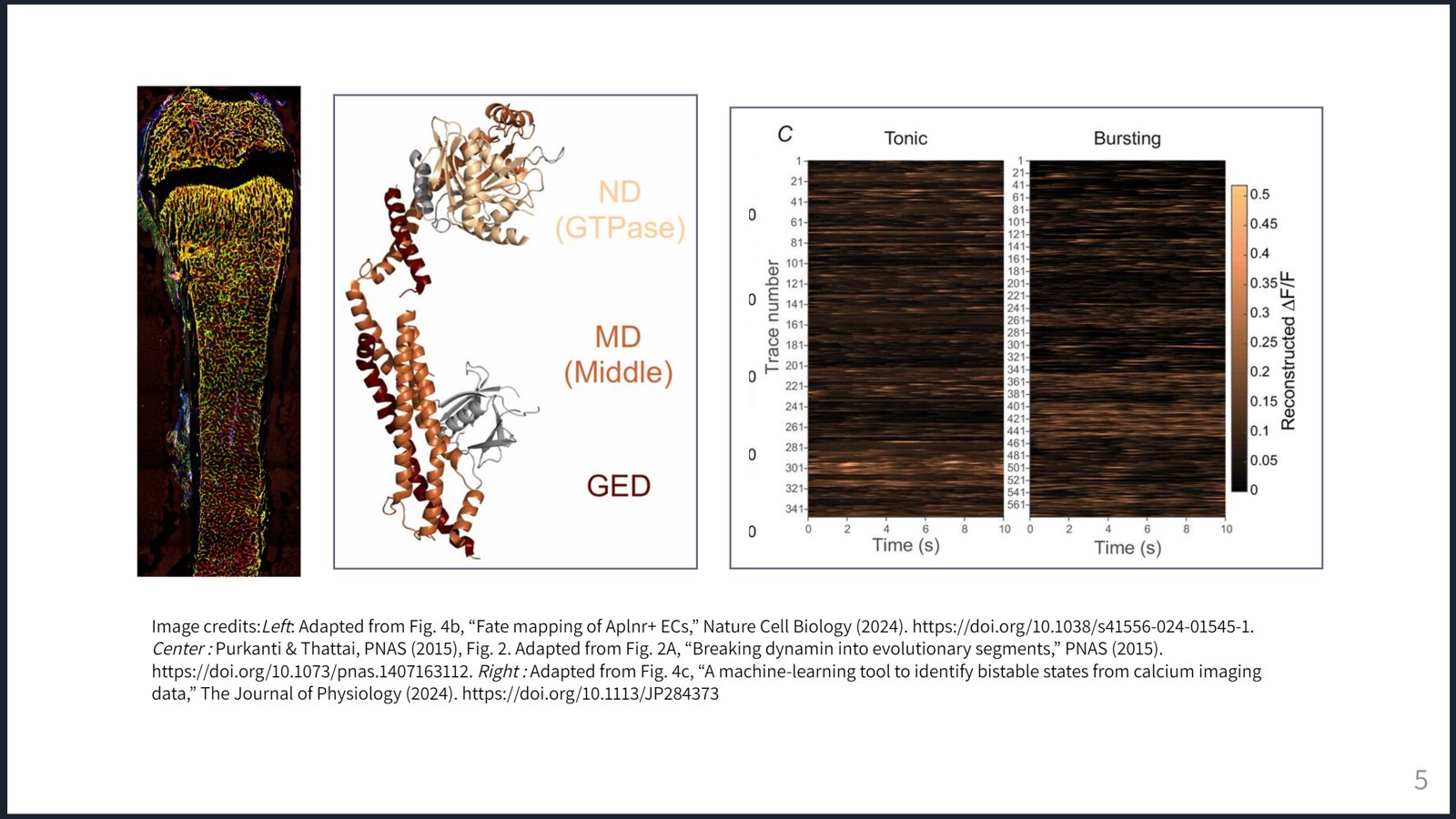
There are examples all around here at NCBS. On the left we see that Soumyashree Das of NCBS has worked on identifying and following particular cells in bone. In the middle, Ramya Purkanti and Mukund Thattai compared present-day proteins to infer what an ancestral form of that same protein might have been like. And they even referred to the protein, a biomolecule, as a living fossil.
Here, Aalok Varma, Mohini Sengupta and Vatsala Thirumalai worked with collaborators from IISc to transform neuronal activity—recordings of a neuron performing neuronal things—into visual patterns, into a heat map that records two different activity states which are called tonic and bursting. But unlike Magritte's oil pipe, these are not simply representations chosen by an artist with the intention of remaining a representation.
They have been produced through the scientific method using things like measurements, comparisons, instruments, colour and various experimental procedures that maintain a particular relationship that can be scientifically tested with the original object of interest—which can be cells in the bone, a protein that continues to exist today and can give information about an ancestral version of that same protein, and about an active neuron or a nerve cell.
And that gap is where uncertainty enters.
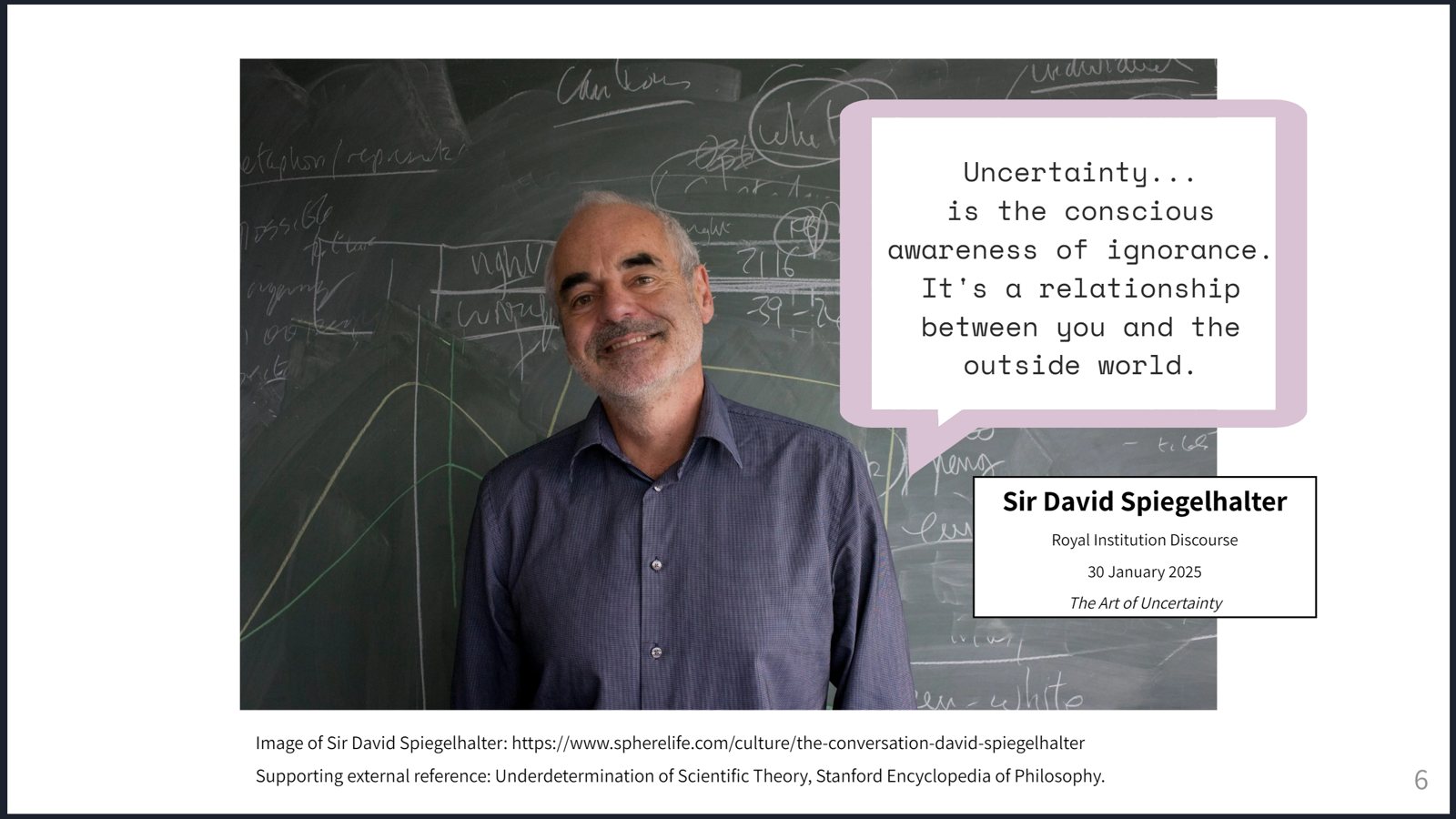
If you can recognize the name or the face, this is a well-known statistician called Sir David Spiegelhalter.
He gives a definition of uncertainty that I find very useful. He calls uncertainty the conscious awareness of ignorance. And he makes a second point. Uncertainty is a relationship between you, the observer, and the world outside you. And that relationship can change as we gather more scientific information because of a better sample, a newer piece of technology, a more sophisticated statistical model.
So, you are constantly perceiving things in the natural world via an intellectual or perceptual relationship with facets of the world around you.
But evidence or what you have perceived as evidence does not come with a bunch of labels containing the importance of that object as evidence. And detective work is often like this too. Clues are not clues until you’ve found them linked to a question you are trying to answer as somebody trying to solve a crime or figure out the identity of the murderer.
Philosophers use the word, philosophers of science in particular, use the word underdetermination for this broader problem where the physical or material evidence you have can restrict the possible explanations for your observation without uniquely selecting one. And underdetermination is one of the reasons why we can understand why scientists repeat measurements all the time, why they are comparing methods, fine-tuning them, and seeking independent evidence qualifying their conclusions in such a particular and transparent manner. So, uncertainty in the meaning of evidence and in the strength of a scientific claim is telling us exactly where the evidence begins and where it stops. What warrant that evidence is actually getting today.
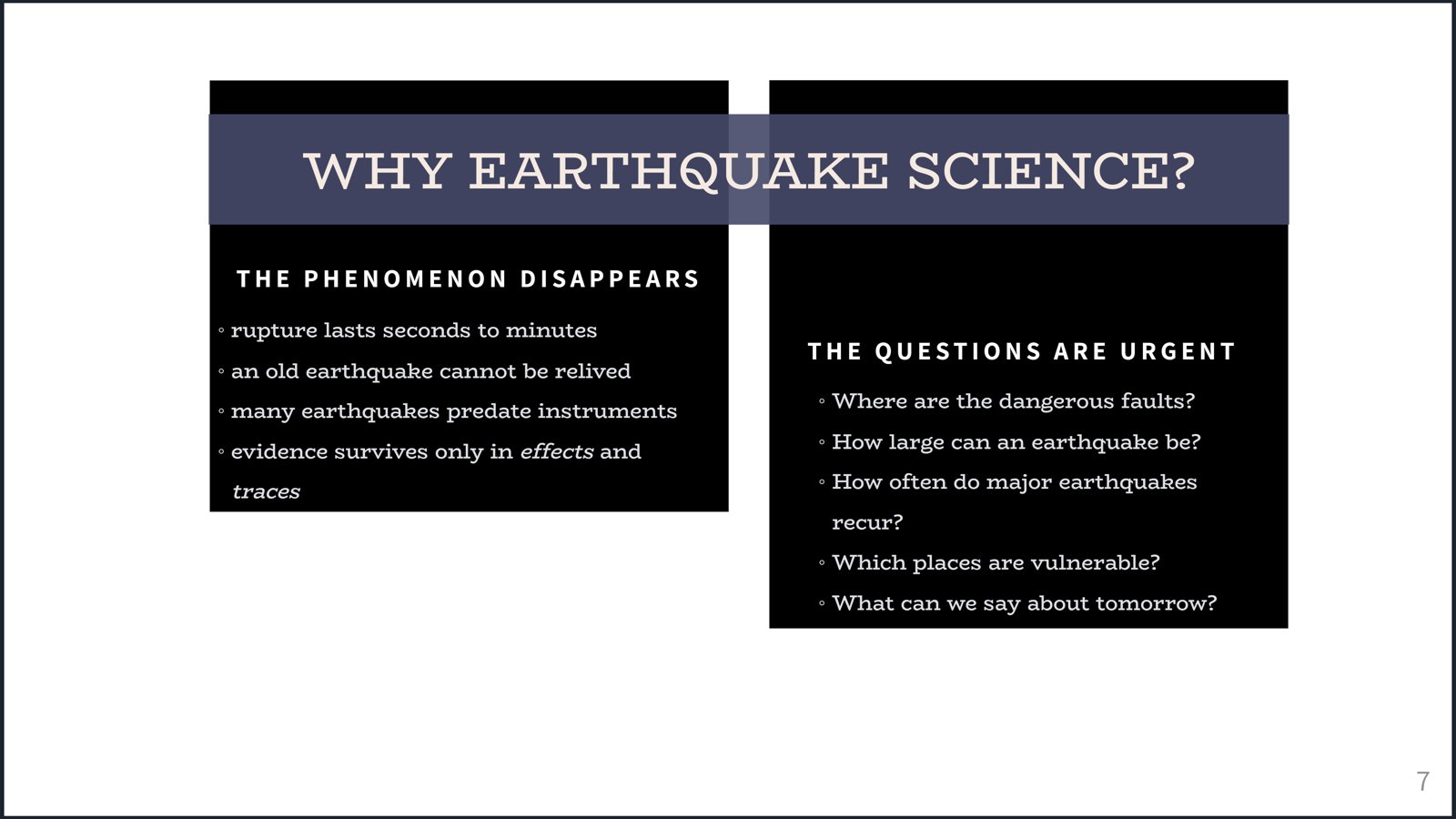
And yet, the questions we ask of earthquake science are overwhelmingly about the future. Where are the dangerous faults in the earth? How large could an earthquake become? How often might we experience major earthquake activity where we live? Which places are vulnerable? What should we prepare for? How should we prepare for it? And I find that there is a strange tension here.
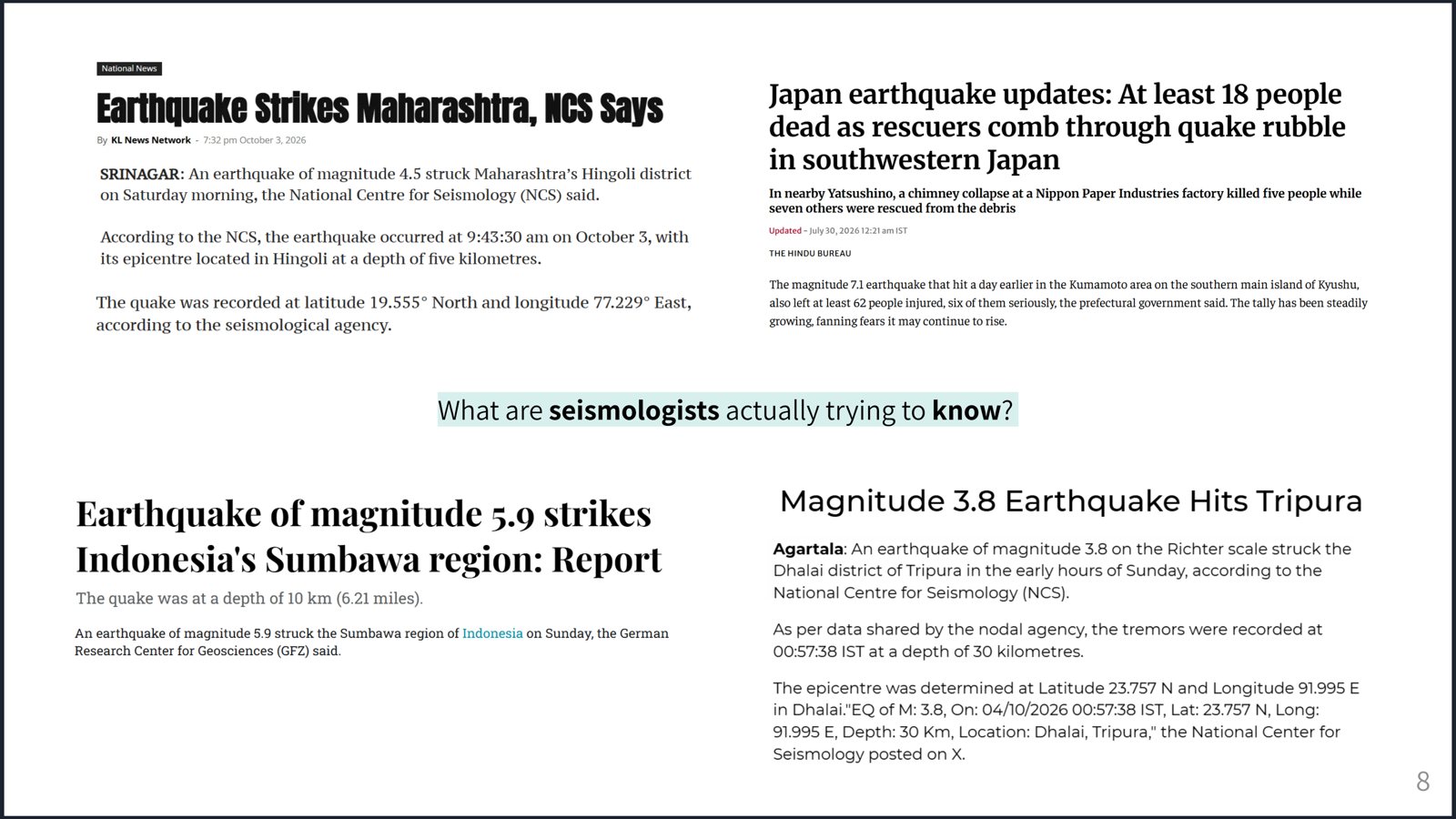
The science is often trying to reconstruct earthquakes that have already happened and disappeared. But society is asking that knowledge of the past and the deeper intimate relationship with the past to tell us something about events that haven't even happened yet. Let's do a little thought experiment.
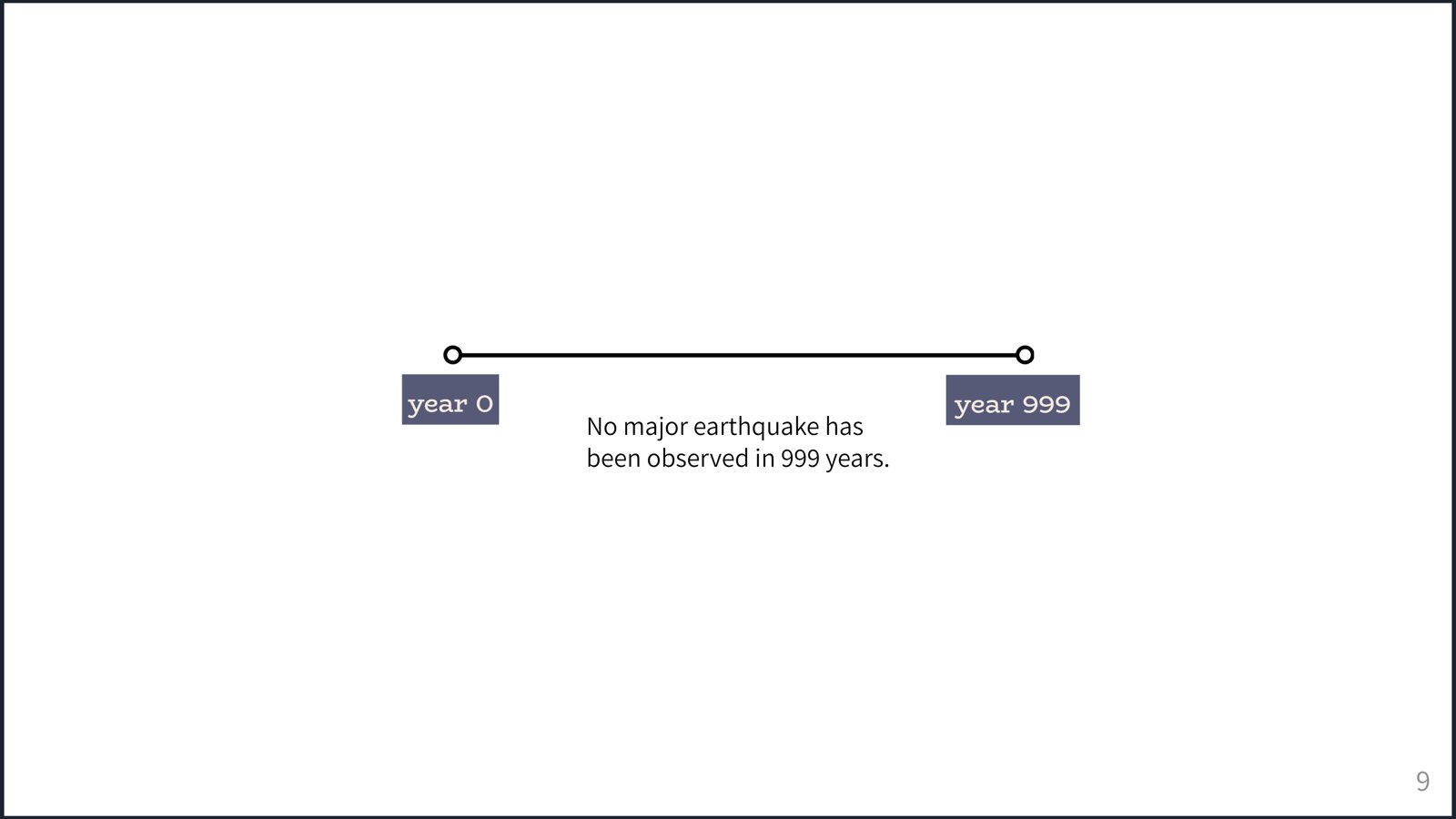
We are in some hypothetical place with plenty of oxygen. We are standing in the year 999. We are currently at this point in time.
And as far as the historical or instrumental record available to us can tell us there has been no major earthquake in the past 999 years. And now, I'm showing you several possible futures.
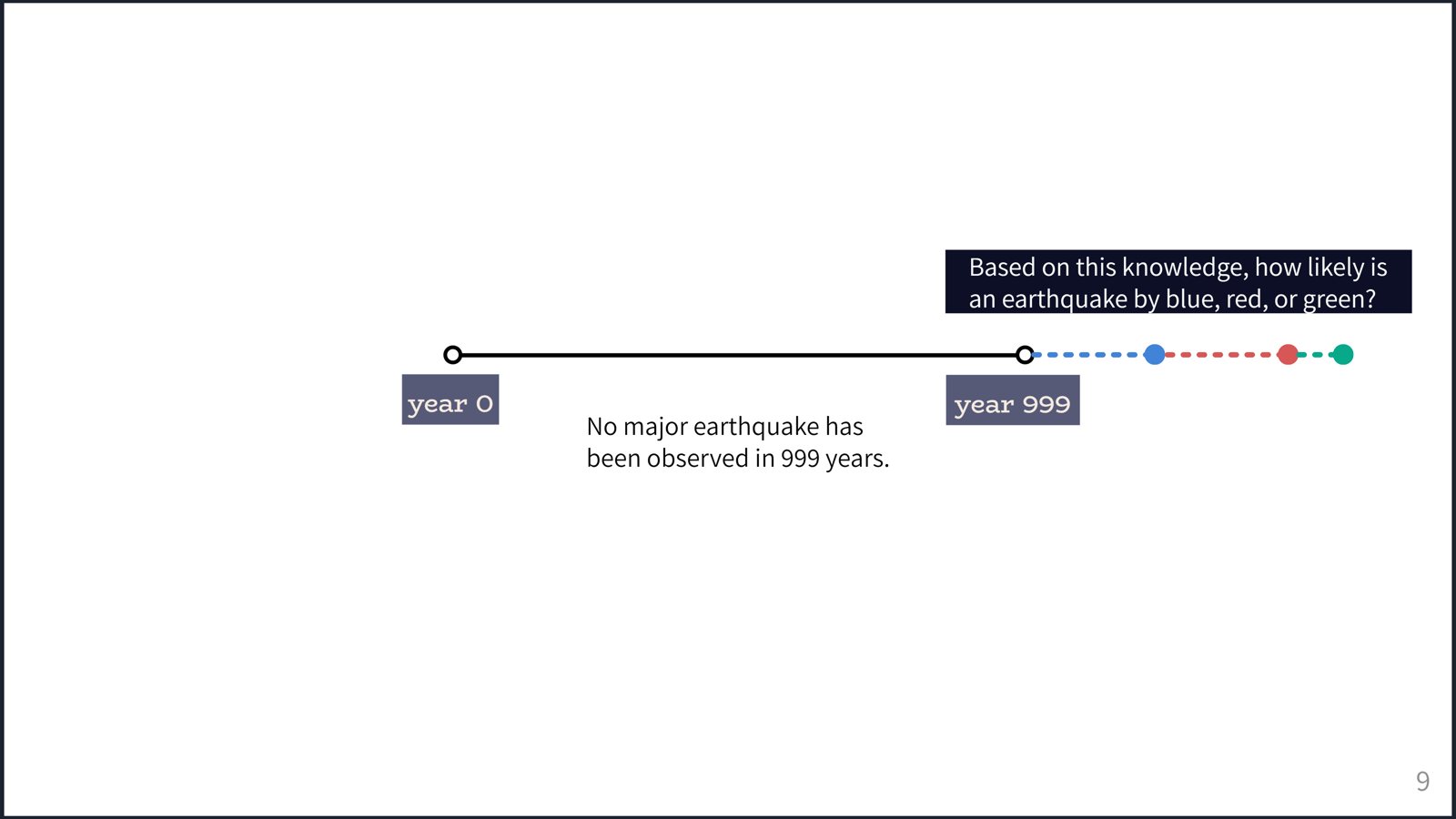
Based on the information I've just given you that there have been no major earthquakes recorded in the past 999 years how likely is an earthquake to occur before the blue dot? Or before the red dot? Or not until much later, before the green dot? And try to think about the question by changing roles.
What if you were the seismologist being asked this question? When exactly in time, in the future, is an earthquake likely? What if you were an administrator who has been assigned the responsibility to allocate resources for earthquake-proofing or evacuation or safety education? Or what if you were just a citizen who wants to know whether you're going to lose your house or your family?
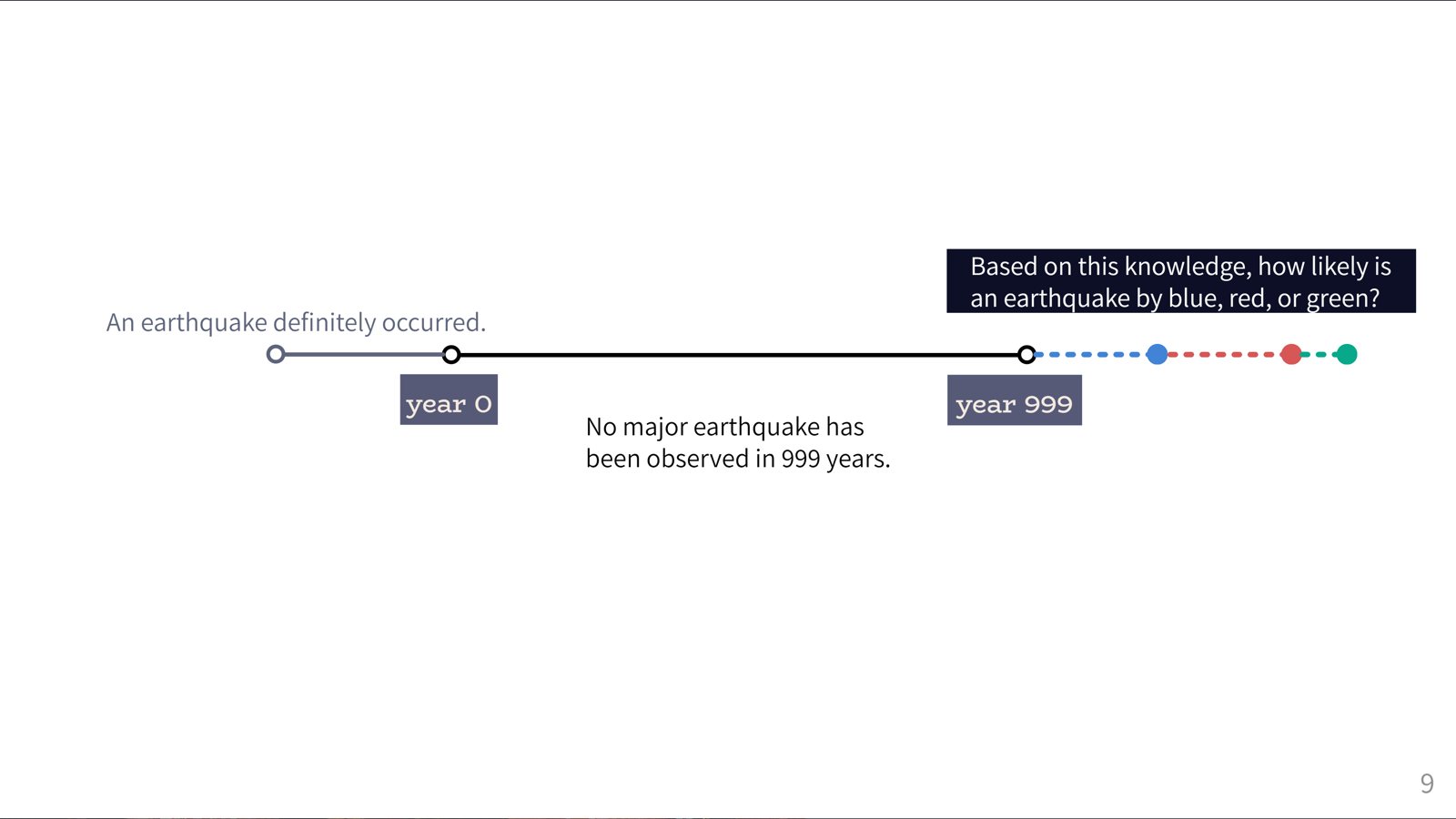
And now, thanks to science and history let's assume we have one more piece of evidence, which is an earthquake definitely occurred in the past and specifically in the grey dot period. And now we're trying to answer this question again.
What has changed? What will we justify in believing at the earlier moment before this information came to us? And what would we as a seismologist or an administrator or just a regular citizen need to know before becoming more confident in whatever we're expecting to happen?
This is not just a hypothetical scenario because on 30th September 1993 a massive but shallow earthquake struck in the Latur district in Maharashtra near a place called Killari.
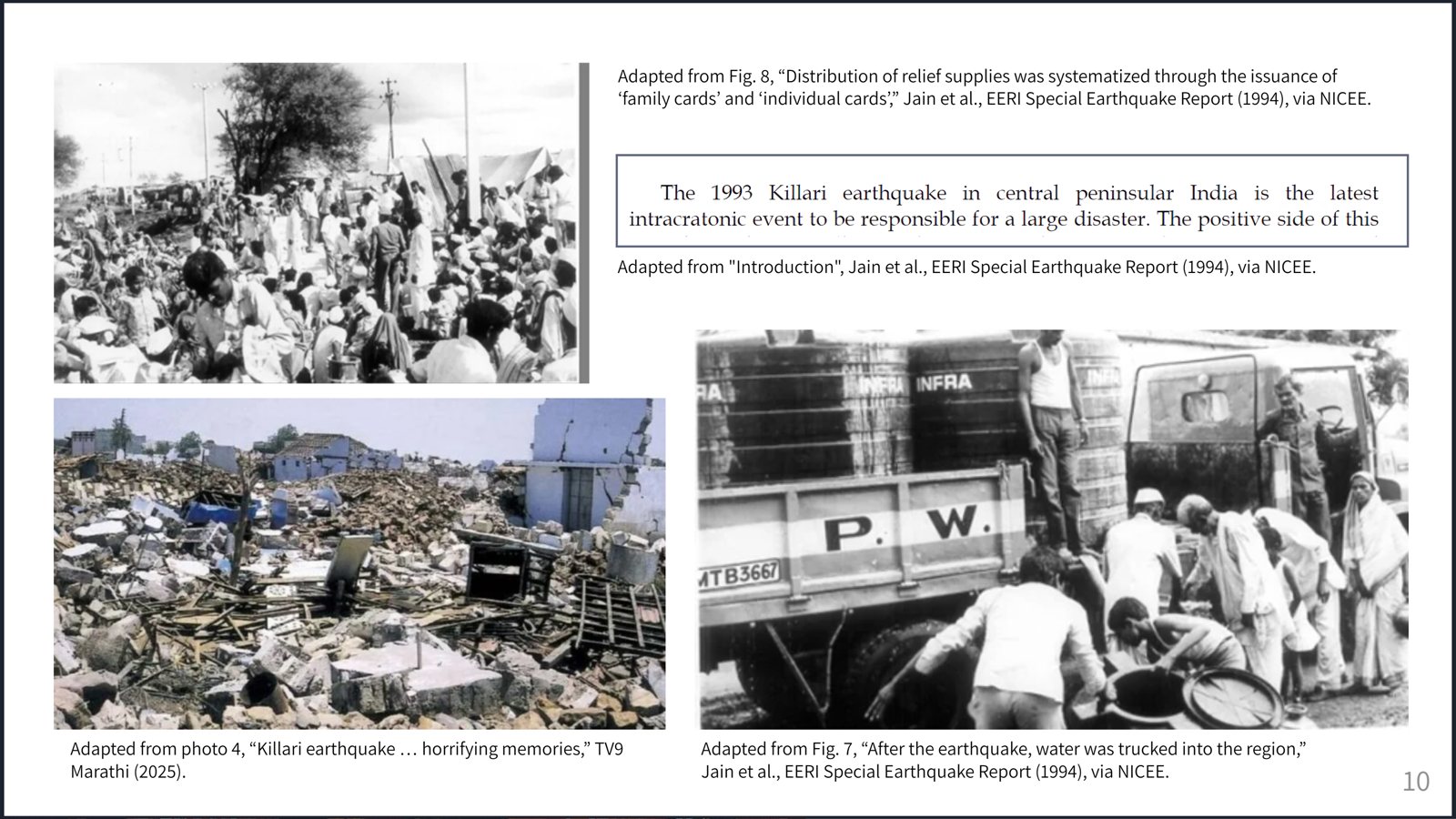
And the magnitude was roughly 6.3 to 6.4 which suggests significant damage. And around 9 to 10,000 people were killed in this earthquake. And the material losses were almost 1200 crore rupees.
What made this Killari earthquake scientifically startling and especially devastating was that nobody saw it coming. It happened at 3.56 in the morning. Hours after that year's Ganesh Chaturthi celebrations had concluded most of the people who died passed away from the earthquake in their sleep never even realizing what happened.
And nobody expected it because this place called Killari lay in a part of the Indian subcontinent that is so far away from the nearest tectonic plate boundary, nobody expected any seismic activity there. The general logic that's understood is the closer a place is to a tectonic boundary or the edge of a tectonic plate, which are constantly in motion, the more likely an earthquake is because there is more dynamic activity happening around the edges as tectonic plates shift. But Killari was nowhere near a tectonic plate boundary.
How did this get such a devastating earthquake? In fact, the danger level Killari had been assigned was Zone 1 which is the least seismic risk zone in all of the Indian subcontinent. So why was there a massive earthquake in Zone 1? The Rajendrans, the seismologists of our interest, would later write that Killari had, I quote, exposed the inadequacy of seismic zoning and raised questions about the presumable stability of other Zone 1 regions in the country.
And after the Killari earthquake the classification of hazard across the Indian subcontinent had to be modified to incorporate this new piece of information that an earthquake can in fact happen in a place that we thought was perfectly safe.
But this does not mean that the earlier classification of Zone 1, Zone 2, Zone 3, Zone 4 and Zone 5 was foolish or poorly done. It just means that classifications are made from available evidence using sensible theories and evidence is always incomplete. Historical knowledge is always incomplete.
And then this earthquake happened which changed the existing picture of what parts of India are at risk of high seismic hazard. So, after Killari, Zone 1 was removed entirely out of the classification. Today there's only Zones 2 to 5 indicating that we can no longer assume that there's any seismic activity-free zone or there will ever be an earthquake-safe zone.
So, when the classification was updated, it did not reduce any kind of uncertainty in the fact that just because we don't have Zone 1 in the classification it doesn't mean that we're suddenly able to predict earthquakes more. The change in classifications of seismic hazard just led to a better-informed map. It didn't necessarily do anything about forecasting earthquakes like an oracle.
One more example comes from Italy.
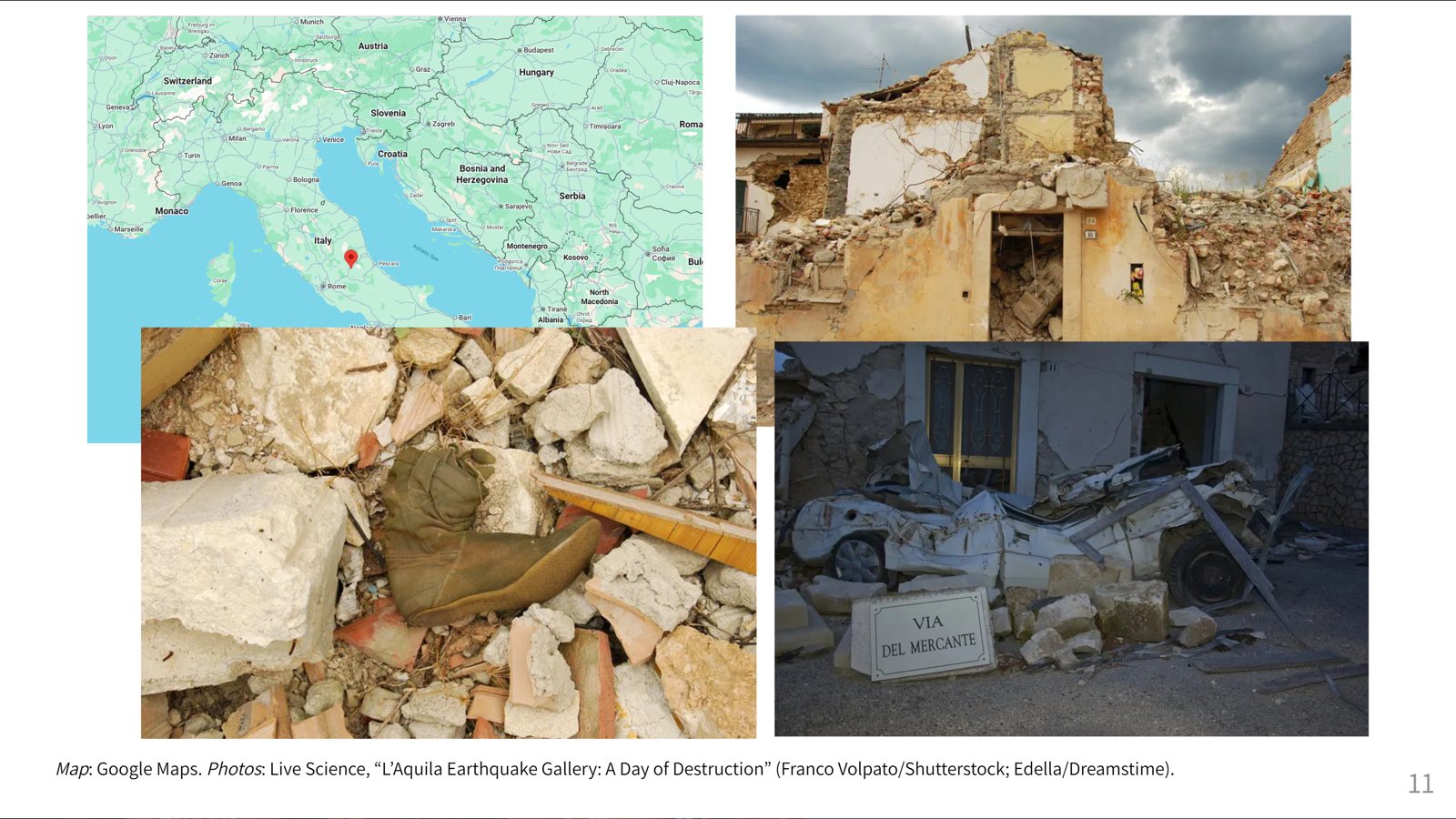
A tiny region in Italy called L’Aquila which is spelled L apostrophe Aquila. And what happened here shows almost the opposite problem of what happened in Killari.
For several months before the earthquake struck in 2009, the region had experienced a swarm of earthquakes, which resembles the third graph you can see on the board. These graphs were stolen directly from the Rajendrans’ book. A swarm refers to a bunch of tremors happening rapidly after each other without any one earthquake or one seismic wave standing out significantly as the main one.
So, living in a place with a swarm of earthquakes, people naturally became concerned. Are we in danger? Is there a bigger earthquake coming? And unfortunately, scientists at the time could not reliably say what it means that there is an earthquake swarm. Because there is no known logic to expecting a swarm and then an earthquake or a swarm necessarily following every large earthquake or any other permutation we can think of.
And that was scientific uncertainty. Our inability to use the information that a swarm has happened and then predict what next. A senior civil protection officer in Italy due to hubris or the greed for political street cred gave an untimely television interview in which he said the swarm is a good thing: the swarm means that a lot of pent-up stress in the earth has been released and therefore there is nothing left to burst out in the form of a massive earthquake.
Later, we find that scientists who had actually studied this put no stock in that expectation at all. Because there is no reason to believe one or the other.
But because this senior civil officer said this in a public interview in a very untimely fashion, people believed that it was safe to leave their homes despite the swarm and go out and make money, drink some wine. Six days after the interview was televised, a magnitude 6.3 earthquake struck L’Aquila; 309 were killed.
So for our purposes, the important distinction here is very very small and very large. The sentence — that sentence — is not the same statement as saying a large earthquake will not happen. Our inability to predict is not negative confirmation.
And in this case in Italy, the forecast uncertainty didn't stay as uncertainty because somewhere in the movement between scientific institutions and government institutions and the public, it became converted into false reassurance. And there is a lot of drama surrounding this case because it is one of the few instances in which scientists were charged with manslaughter for not predicting an earthquake. And in the end, only the one civil protection officer was actually jailed.
And there was a huge outcry from the scientific community about blaming the scientists for the loss of lives. When the scientists were later acquitted of all this blame, people were outraged yet again because there seemed to be nobody paying for those 309 lives lost and for an entire town's destruction. And that question of how many different ways does uncertainty exist when we are dealing with earthquakes, when prediction is so important to society, became concrete for me through the C. P. Rajendran and Kusala Rajendran papers.
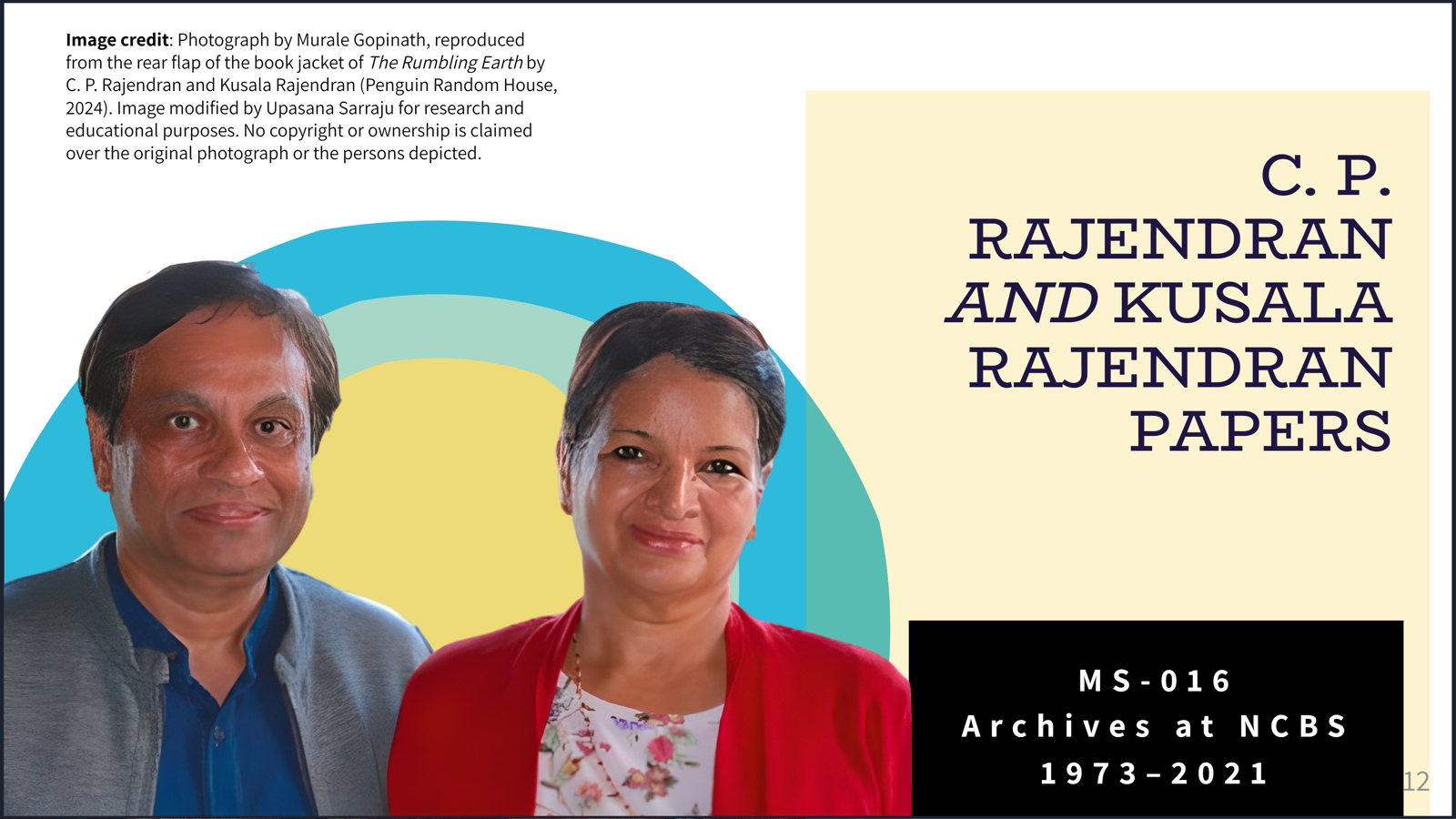
The Collection covers material from 1973 to 2021 and contains so much more than final, formalized scientific knowledge. It contains correspondence, field records, sample records, analysis, a lot of bureaucratic emails, newspaper clippings and so much more. Which means this was actually exciting because one could spend time on these papers and view scientific knowledge in many different forms and view how many ways one scientific claim can be expressed on paper.
Which is why the sub-title of the talk is A Documentary Life. And if I can be excused for sounding over familiar, I will call them by their first names or initials. C.P. trained in geology and Kusala in applied geophysics.
They met in 1980 as young scientists in the Centre for Earth Science Studies in Thiruvananthapuram and married a year later. In 1988, Kusala Rajendran left for the U.S. to study at the University of South Carolina and C.P. joined her later. They also had a wonderful son and a family.
And in the U.S. they worked with another very well-known geoscientist called Pradeep Talwani. And that is where a major interest in paleoseismology took hold in C.P. and then a little later in Kusala. They returned to India in 1993.
Less than two months after their return to India, Killari struck.
So, because we were unable to predict Killari and save a lot of lives it gives us the impression that earthquake science and earthquake scientists have very little that is certain to say. But that's not true.
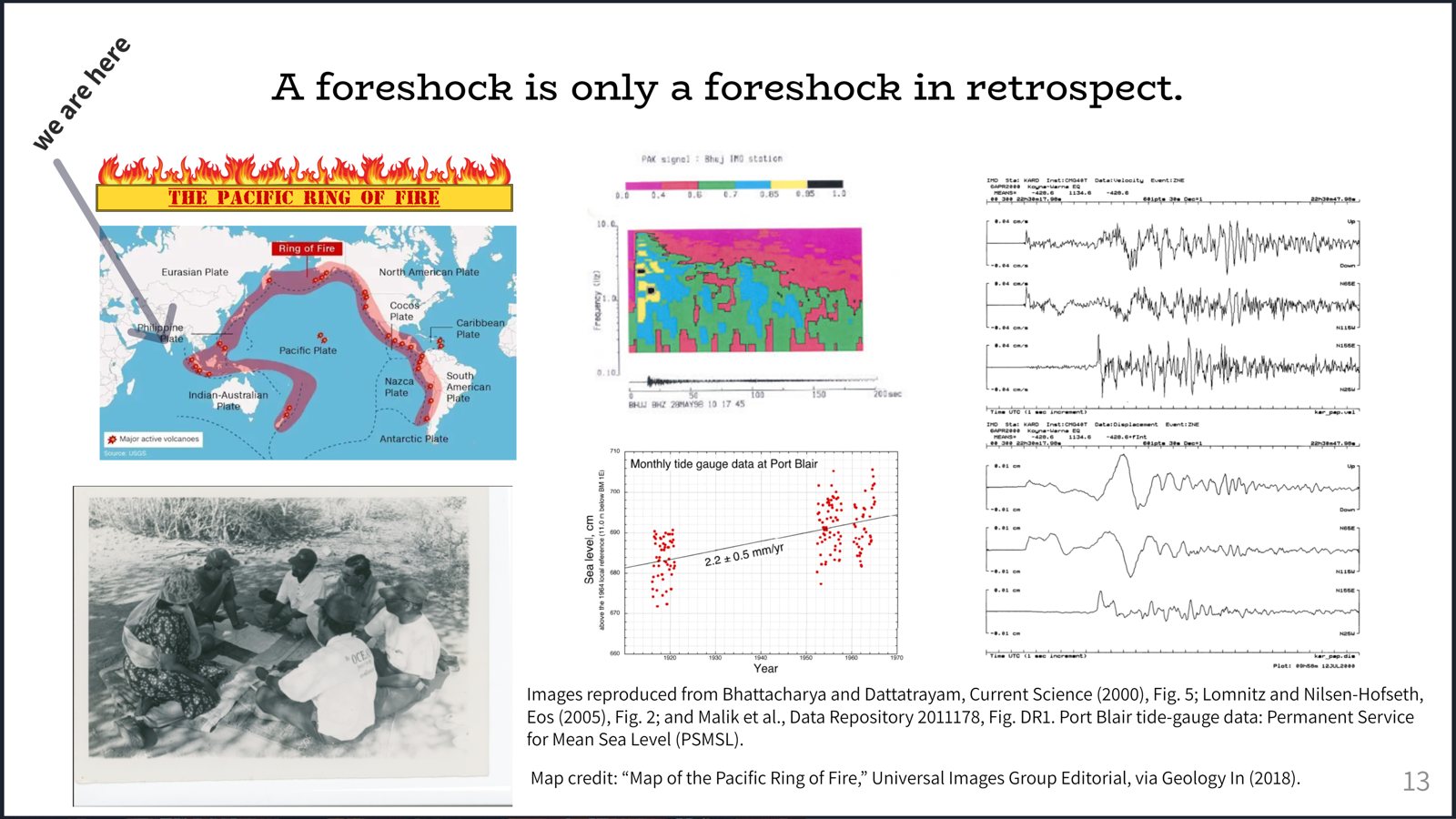
We actually as a species we understand a great deal about how earthquakes happen. We know that stress does accumulate in the earth's crust. We know that faults, which are created by two blocks of rocks, can be locked thanks to friction and at some point of time, because of the release of tension, one of them might slip, creating a fault.
Once an earthquake has happened, we can estimate exactly the mechanism of rupture in the earth. We know how large the earthquake event would be. And we know how the fault and the seismic waves move in the earth.
But isn't explaining the process a little bit different from predicting a particular future earthquake? Because a deterministic prediction of earthquakes should need to tell us, exactly where an earthquake would happen and exactly with what magnitude would the event happen. And we are currently unable to do so. And maybe after the talk, we could talk a little bit about why that is the case.
What makes earthquakes so unpredictable and un-understandable. There is currently no reliable method for predicting earthquakes. So, throughout this story we willbe encountering many ways in which earthquake science is productive andimmensely useful and other ways in which it's okay to feel let down by the lack of earthquake science's ability to predict earthquakes.
We can't collapse prediction, forecast, hazard warning, risk and early warnings as the same thing. They are all emerging from the same fountain well of seismic knowledge or seismology knowledge. But they are surviving on very different scientific claims.
And just a couple of last points before we get into the documents themselves.
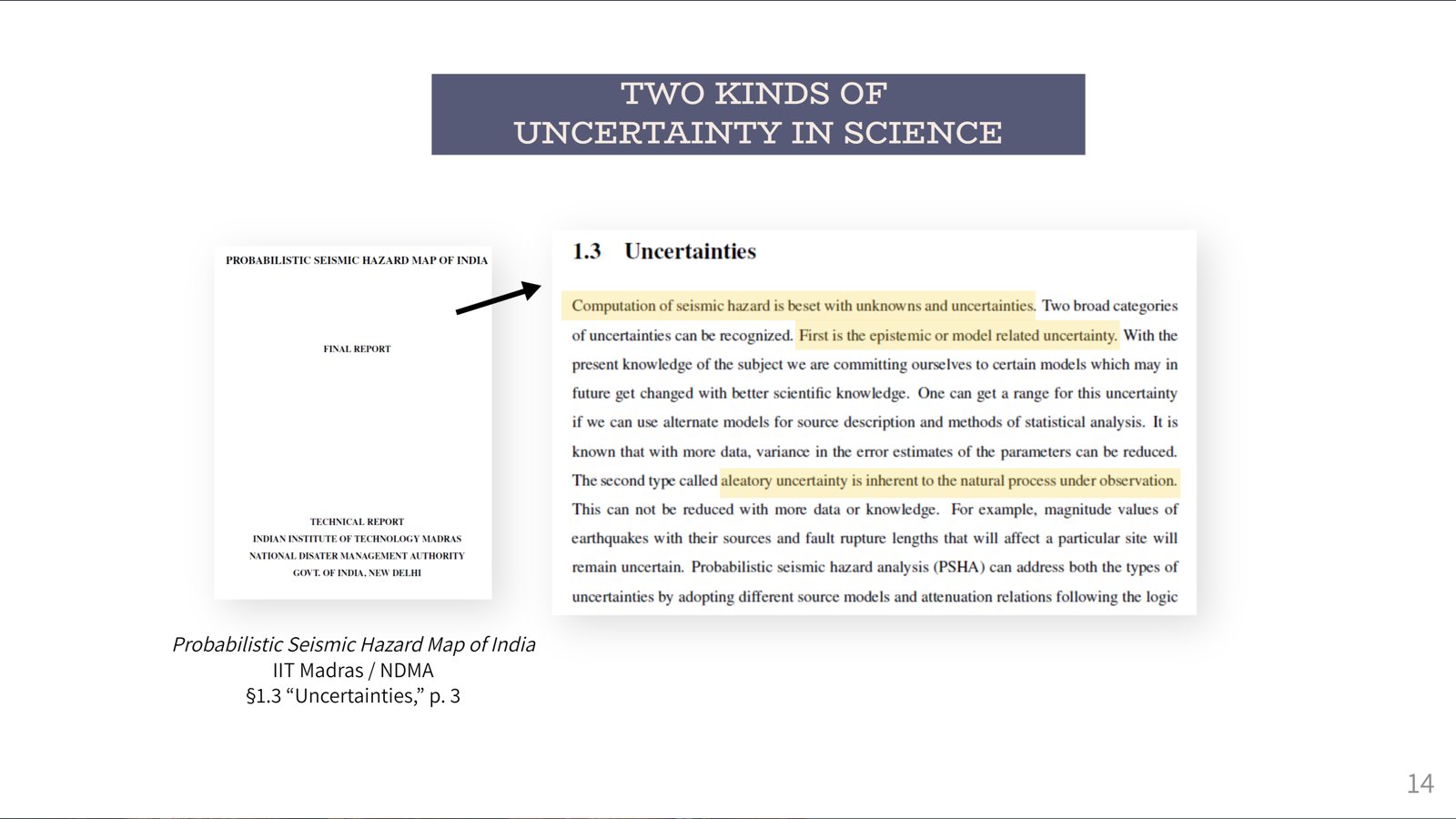
Hazard science: the aspect of seismology that is focusing on how much danger a particular place can potentially be in. Like we already talked about with Zones 2 to 5 in the seismic hazard map. The specialization of seismology focusing on hazard science itself gives us two wonderful definitions and two distinct ideas in a section called uncertainty from a report called the Probabilistic Seismic Hazard Map of India.
This was a project that was done by IIT Madras in conjunction with NDMA, which is the National Disaster Management Authority. And in the very first section, we find a subsection called Uncertainty telling us that there are two kinds of uncertainties in science. One is epistemic or model-related uncertainty, right there.
This comes from limitations in knowledge, which can be corrected by gathering more historical information. Collecting better samples, coming up with more sophisticated models maybe, meaning that some of epistemic uncertainty can be reduced by better evidence.
Then we have another kind of uncertainty called aleatory uncertainty, which is the uncertainty built into the natural process itself. No matter how refined our data is, no matter how well we have mapped the earth's crust, we can't turn an irregular event into a regular one. We can't force earthquakes to recur in a periodic fashion, and they just don't.
So then it seems to be wise to ask what is the goal of seismology or even science in general.
Maybe science is not about reducing uncertainty all the time but identifying what uncertainties exist. Which ones can be reduced and in what ways. Which ones can't be reduced no matter what.
And most importantly which kind of uncertainty matters to the scientific question that is trying to be answered.
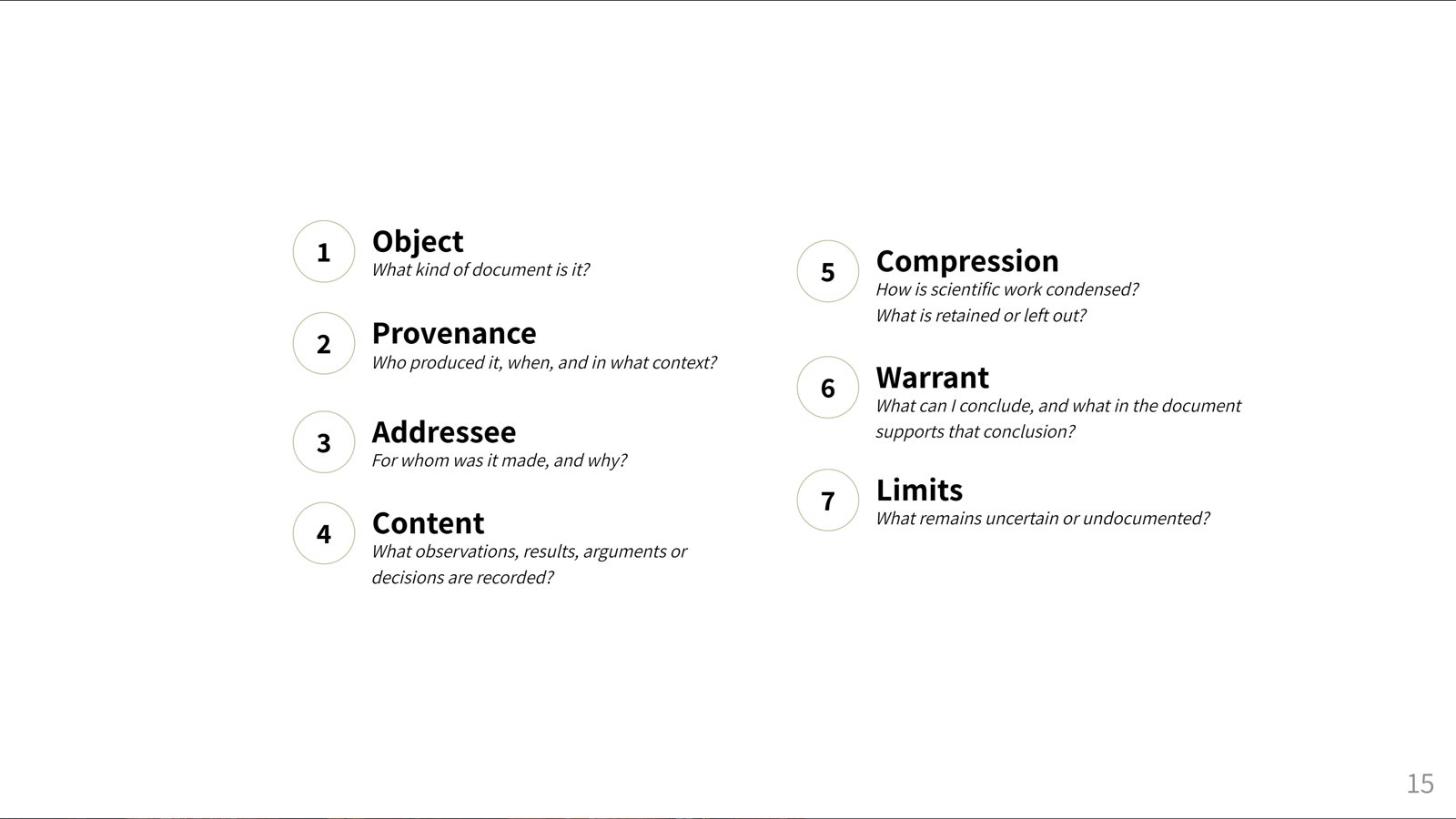
And keeping this in mind when we look at a bunch of different documents from very different genres—all from the Rajendran collection—one is forced to find some common bearings across the analysis of all the documents.
I have made a tentative list of seven questions I can ask of every document, to make sure there is a consistent approach being followed.
And number seven, limits, is not just about the limits of what that document or report is claiming, but the limits of what I can claim of the document.
Which means, a guiding principle became do not make the document say more than it is justifiably saying.
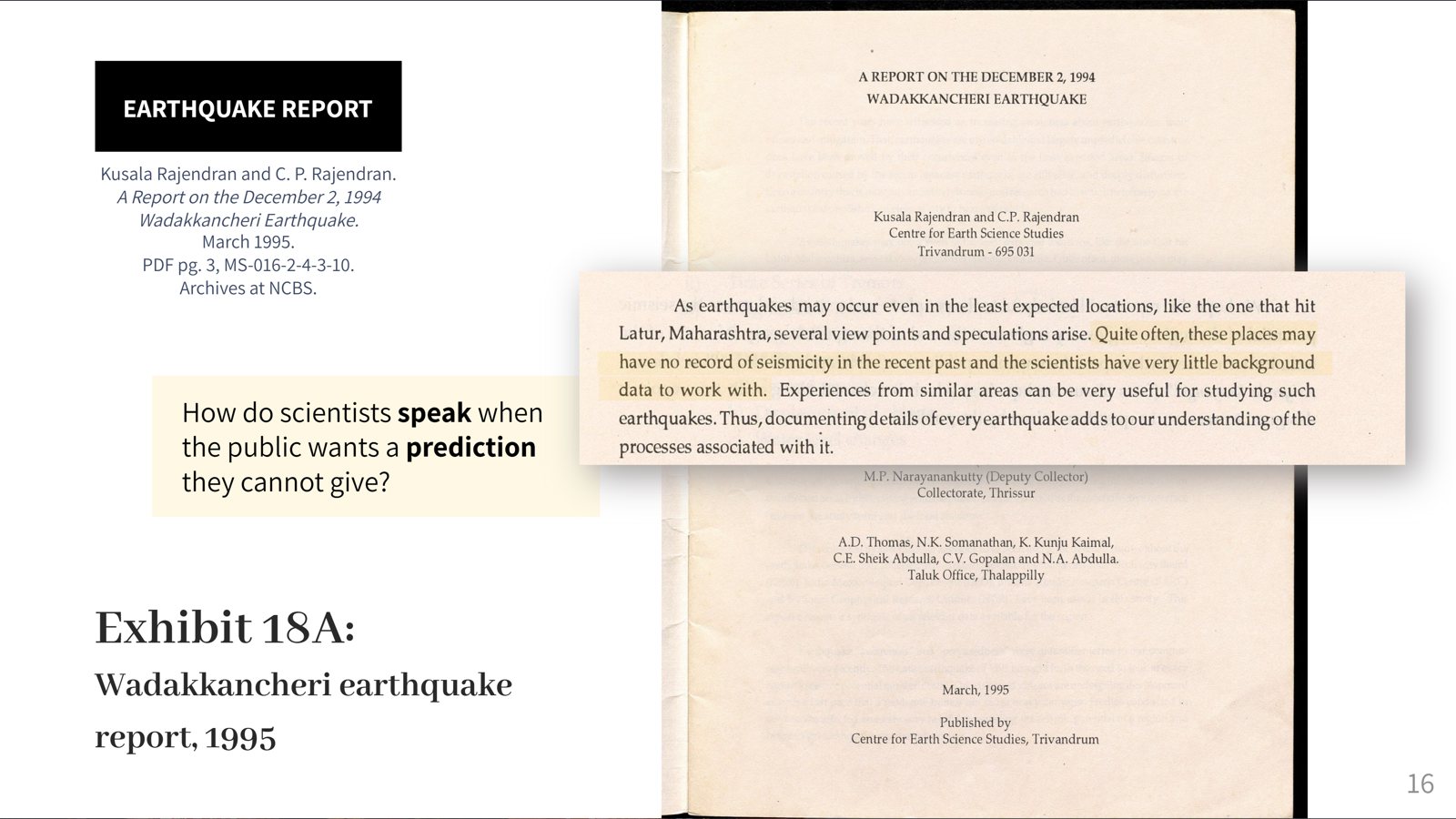
We are starting with an earthquake report, specifically a report on the December 2, 1994, Wadakkancherry earthquake in Kerala which was prepared by Kusala Rajendran and C.P. Rajendran, using their own field observations and also seismic data from agencies like the Karnataka State Electric Board, the India Meteorological Department, Bhabha Atomic Research Center, the National Geophysical Research Institute.
When an earthquake struck Wadakkancherry in Kerala in December 1994, it was a moderate earthquake, the magnitude was 4.3. And the main earthquake was followed by many small tremors.
Similar to Killari, Wadakkancherry did not have a particularly dramatic history of seismic activity, which means the people who lived there were terrified of this sudden burst of tremors. In fact, some of them ran out of their homes and spent the night in open fields in tents, because they had never experienced this sort of a situation before. So scientists from the Centre for Earth Science Studies,including Rajendrans, investigated the earthquake a few months later and prepared this report.
Now, because this earthquake happened in 1994, exactly one year after the Killari earthquake, there was a lot of concern about what if this is another Killari. Or what if there is another Killari coming and these tremors that happenedare the early signs. What if we are underestimating the risk at this point.
And so, this scientific investigation was taking place at the same time as a very human question, which is, is something bigger coming? Are we in graver danger?
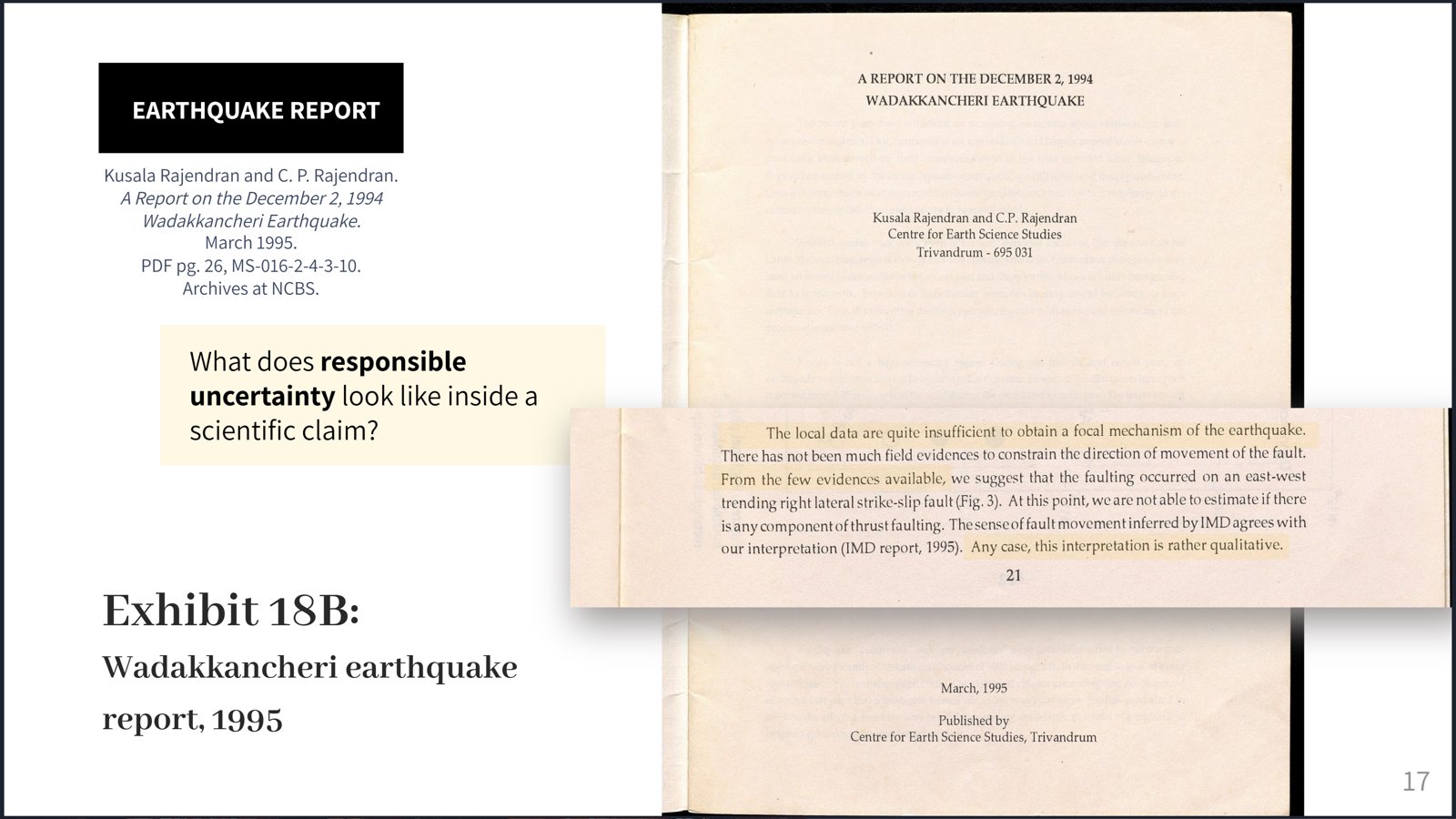
In the same report just a little bit later on page 21, the problem becomes about identifying the exact mechanism that led to the formation of this earthquake, which they refer to as the focal mechanism. The report itself says the local data are quite insufficient to obtain a focal mechanism of the earthquake. There has not been much field evidences to constrain the direction of movement of the fault. From the few evidences available, the scientists suggest certain ideas. But they qualify their interpretations of what happened and how this earthquake happened in a very responsible manner. You can see that in this last highlighted sentence, in any case this interpretation is rather qualitative.
Then, this report nevertheless suggests something specific. Like in an east to west trending right lateral strike-slip fault. And they also, the scientists here, tell us how much confidence to place in their interpretation. Because as experts, their opinion can often be carried further than the evidence actually supports.
And I love this qualification. Just so upfront, so straightforward. Because they are not saying we are uncertain of what happened and therefore nothing can be said and washing their hands off the whole thing.
But they also aren't turning one plausible interpretation into some kind of an established fact. So here we find that the strength of the claim is still answerable to the strength of the evidence per the scientific method.
And that changes, or at least it's a chance to change, how we think about objectivity. Maybe objectivity is not about a complete absence of uncertainty, nor is it 100% proof that this was the only possible sequence of events. Maybe objectivity is about identifying the weaknesses and the limitations of the claim. And maybe scientific claims that are qualified in this manner are not weak, but the limitation is part of the result.
By which I mean the result of this investigation or any other investigation is incomplete if we remove the results' limitations. So, the use of scientific findings is complete, it's potential is met, only when it is also accompanied by an open addressal of the limitations and the uncertainty associated with that claim.
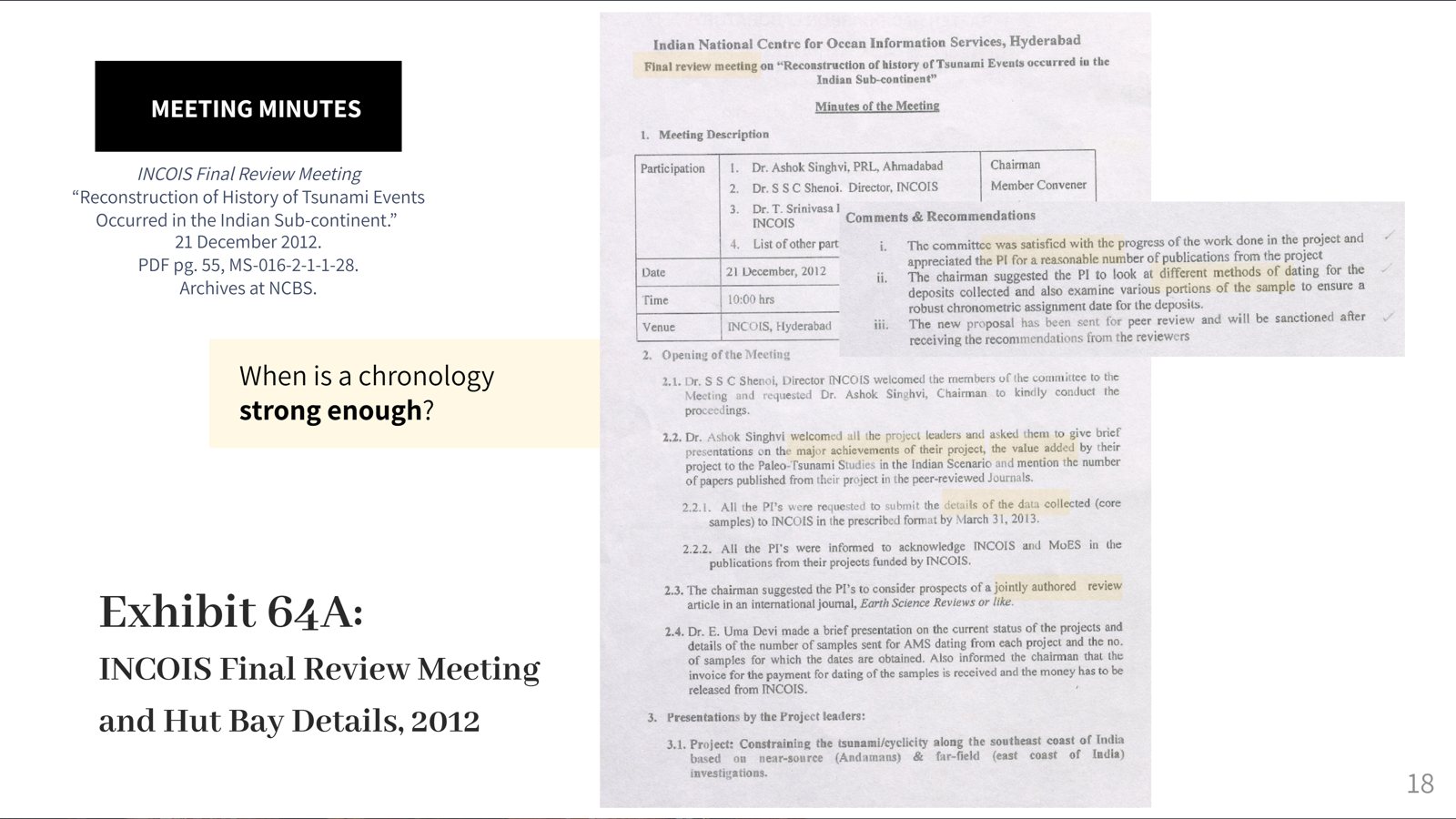
The next document we are looking at is quite interesting. We are going into a sort of an institutional space. It's from INCOIS which is the Indian National Centre for Ocean Information Services in Hyderabad.
There is a committee overseeing a particular project under which many research studies are being conducted. And this document we are looking at is the minutes of a final review meeting conducted by that committee, in collaboration with all the different PIs whose work is being overseen by this specific committee from INCOIS.
The committee convened and asked the various project leaders and PIs to list the major achievements of their product, what data they found, what value they have added to the human body of knowledge concerning paleoseismology, which is about really ancient earthquakes—earthquakes that may have happened well before instrumentation even existed or well before there were any accounts of it even in recorded writings or illustrations. The PIs were asked to share details of what data they collected. The PIs are encouraged to consider a jointly authored review.
And then comes a pair of judgments. The committee chairman is happy with the progress, appreciated the PI for a reasonable number of publications on the project, and the chairman also suggested at the same time to look at different methods of dating for the deposits collected. We will get into what methods of dating means, but for now think of it as a measurement process. So, this juxtaposition is very common in scientific writings, in scientific papers.
There is always something more to improve, there is always something to be appreciated, there is always some way in which knowledge is being furthered but it could be better. But epistemologically speaking, this juxtaposition is rife with information.
It is telling us that progress, scientific progress, progress even encouraged and supported institutionally, can be encouraging and valid while one aspect of the scientific claim can still require further justification. So here, the uncertainty being presented is being used as a reason to do better tests in the future. The uncertainty, instead of holding back progress has become a reason to be productive.
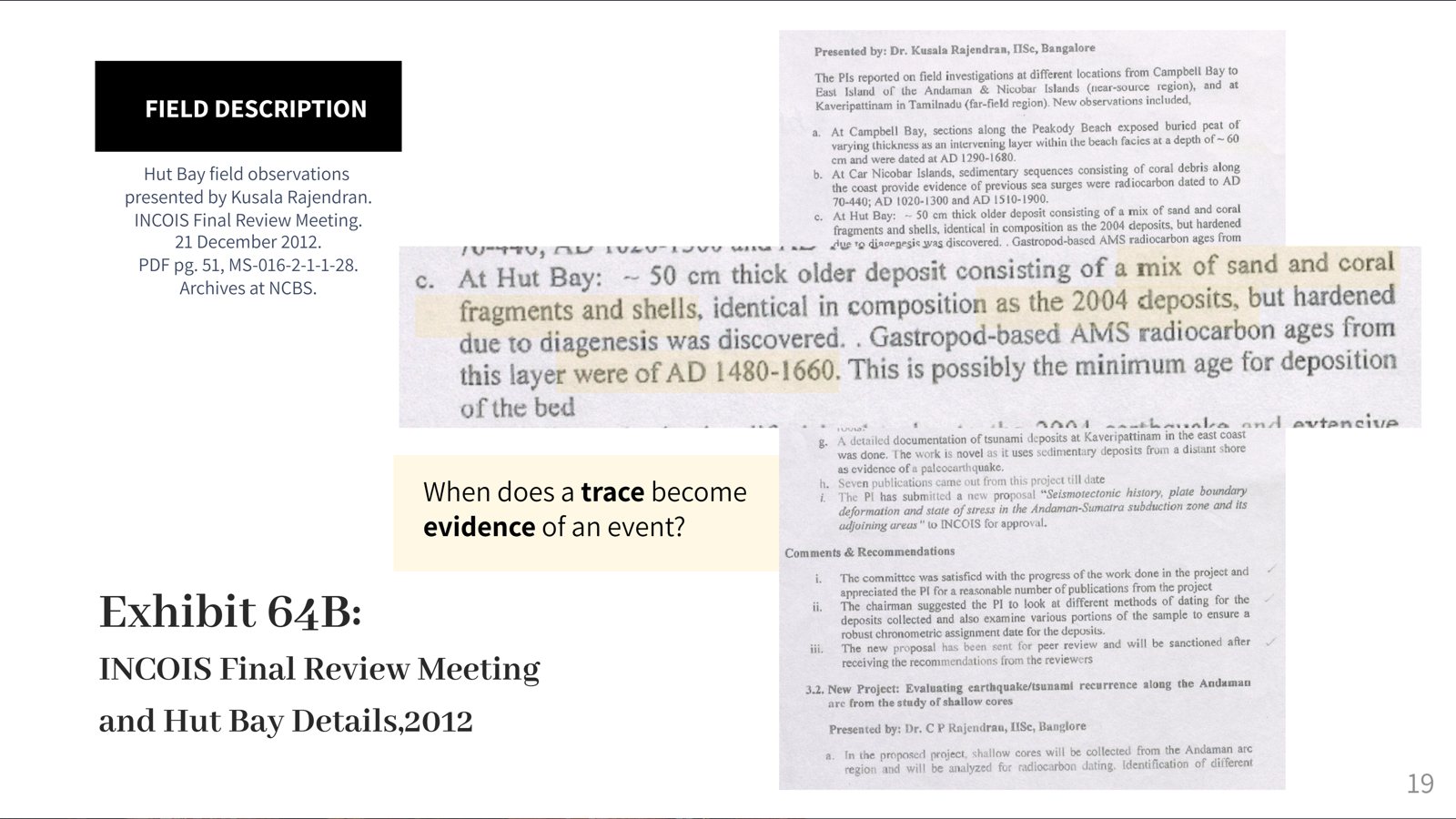
Later in the exact same report, in one section we find Kusala Rajendran actually presents their team's observations of one field site at Hut Bay, which is in the Andaman and Nicobar islands. At Hut Bay, Kusala Rajendran says, they found some sedimentary layers, think of it as layers of soil in the earth's crust consisting of a mix of sand, coral fragments and shells. There is some description of the characteristics and then there comes a comparison with another material identical in composition as the 2004 deposits referring to the massive 2004 Sumatran-Andaman earthquake tsunami where almost 2 lakh people lost their lives.
We also have an initial dating of the sample that was discovered and is being described here. Now this comparison and the presumed resemblance between what was collected and tested from Andaman and Nicobar islands and what else is known to have come or at least has the highest probability of having come from a 2004 tsunami-earthquake is giving the scientists a reason to investigate the layer that they found in their field work. But obviously, resemblance is not causation.
The observation here is that a sedimentary layer, a layer of soil, a layer of the ground, of these characteristics exists. That's the scientific observation. And the fact that it could potentially be connected to the 2004 event, or deposits associated with that event is an interpretation. Because thinking about it from the point of view of the chairperson of the committee: could another process have produced the same characteristics? And if the similarity in composition is just a coincidence, has the material that was collected in this case or even earlier, has it stayed in its original context? Has the surrounding geology also been checked for whether it fits in with this kind of a potential cause? And this is where the word trace becomes important.
We use traces from which we take samples and turn them into evidence. A trace is something material left behind from a natural phenomenon that we are able to access. From a trace comes evidence.
From evidence comes a claim. And that claim travels everywhere and creates all kinds of messy situations in terms of knowledge. And then we have the word proxy, a word everyone is familiar with. The difference between a trace and a proxy is a trace is what is left behind of a phenomenon. A proxy is what lets us access the traces of the phenomenon indirectly.
Sometimes, the same object can be a trace and a proxy of the phenomenon. But neither a trace nor a proxy carries its own baggage of meaning. Meaning has to be investigated and assigned to a sample, to a trace.
Once scientists think that they may have found a geological trace of some presumed past event that is the subject of the scientific question, another problem appears. How do we know that this trace is actually connected to this event?
How old is this sample that you have collected? Is it as old as the event itself? If you happen to know that an event actually occurred independently or through some archaeological records or paintings or sculptures, you want to find out literally how old the sample collected from the ground is.
When was it formed? When did it arrive there? A method called accelerator mass spectrometry helps in finding out the age of any organic sample. When any organic material is found, when seismologists are off in the field collecting bits of soil from here and there, digging trenches, taking pictures, any organic material found, like charcoal, is subject to radiocarbon dating and then to a bunch of other processes to find the age of the sample.
If we know that a sample collected from this trench is these many million years old, these many thousand years old, then we get closer to understanding the distance between that sample and the phenomenon we are interested in.
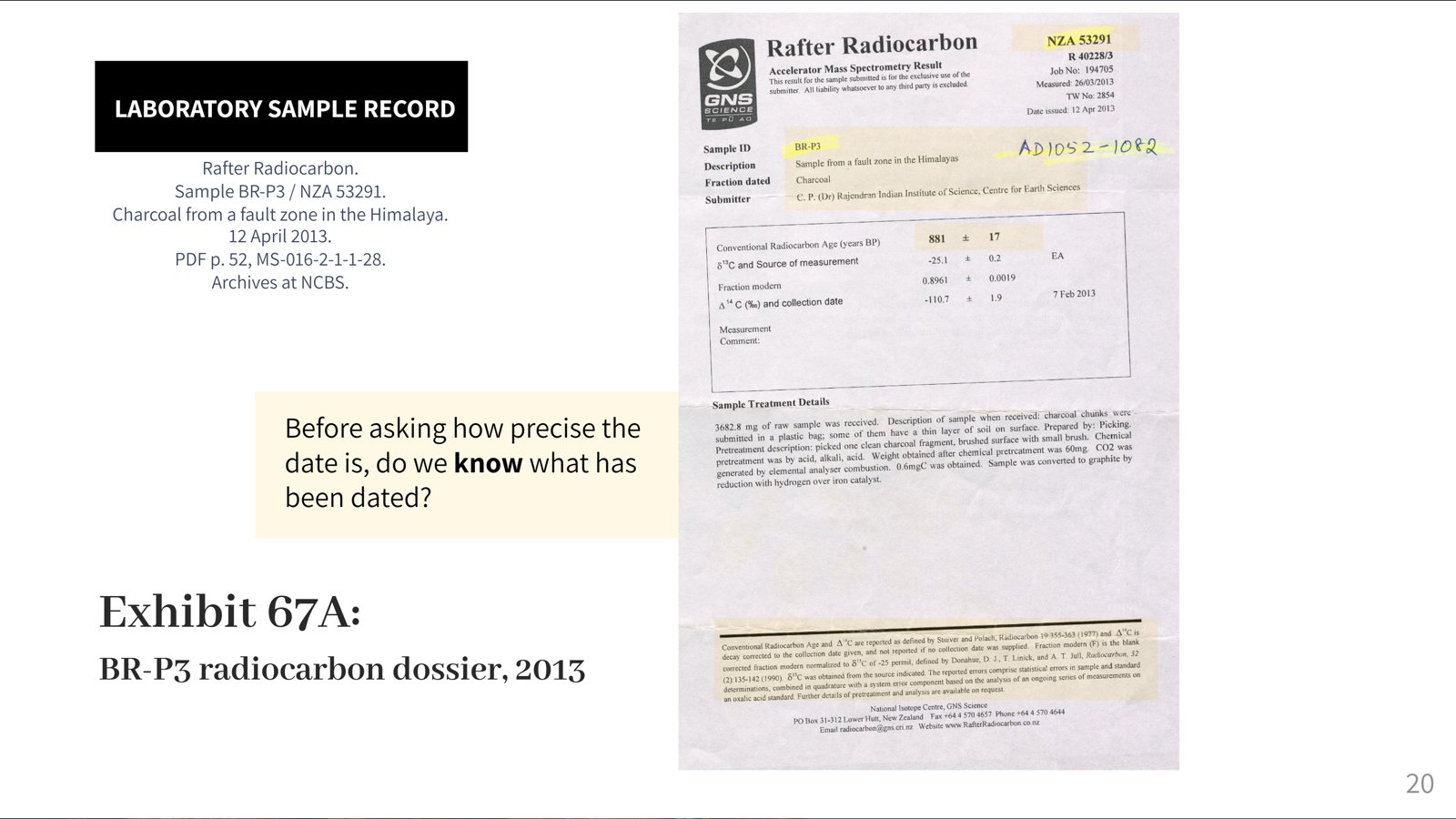
We can continue to look for those links next. But again, there is an important distinction. Radiocarbon dating — just think of it as a method of finding the age of soil — does not date the earthquake. It dates the organic material in your sample. It dates the carbon in your sample.
The connection between this finding from this sample analysis report has yet to be linked to a potential source event where we are looking for confirmation. We have some very interesting information here in the first third. We know that the sample is given a little ID.
There is a description saying the sample came from the Himalayas and the charcoal fraction of the sample was subject to radiocarbon dating. We know that C.P. Rajendran submitted this sample for analysis and was affiliated with IISc at the time. We also know that this particular lab has its own identifier.
Now all of these, especially with you being archivists, all of these may seem like just, you know, “Of course they would be identifying material. How else do you make sense of anything? You need labels.” I know how much you guys like labels.
But this is provenance of a sample. Think about what worth this sheet of paper would have if we did not have this first third at all. This sample number ties the lab result found here, which is satisfyingly numerical, to a particular material; the material to a place; the place to a person who visited that place; and a lab ID to allow all of this information to travel without attaching pictures of field collection and sampling permits and proof that these steps actually did happen the way they are being claimed. So, the lab ID allows this information to travel without requiring any of the actual original sample.
And provenance is not just good archival housekeeping. It is the only thing making this result usable. So, before we ask how precisely did we measure this and how reliable is this number, there's another question. Why is this the relevant thing to measure? Because you can work on the technology and increase the precision of this finding but an extraordinarily precise number can't fix a broken provenance connection between the sample and the event or between a trace and the scientific claim.
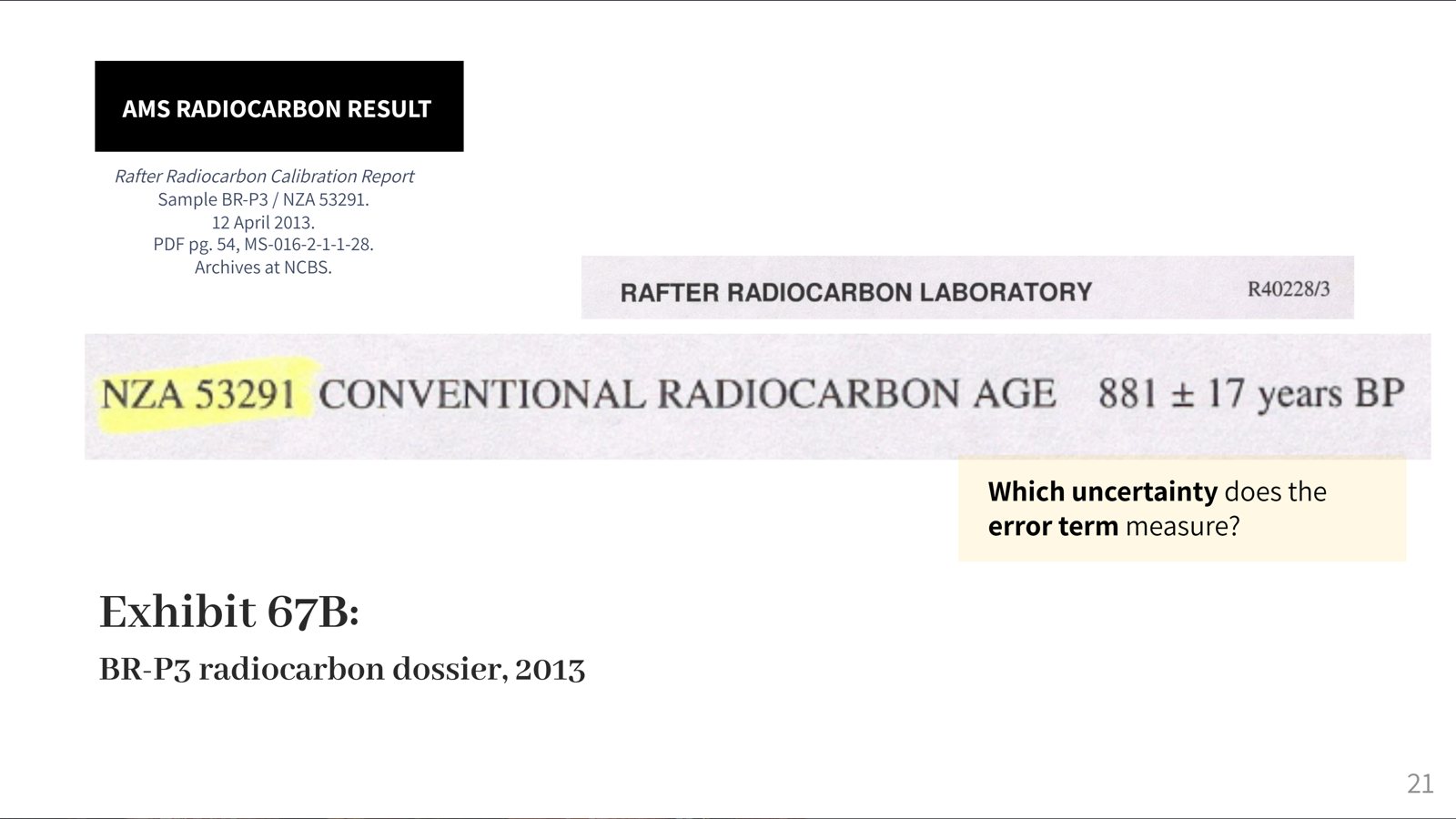
Going just a little bit closer into the same document, the laboratory has given us something numerical, something that looks like it may have captured the uncertainty built in thanks to this error term, 881 plus or minus 17 was BP. If you already know what BP is, great. If not, we can talk about it a little bit later.
Now, what is this error term measuring? Which uncertainty is it trying to reduce? The plus minus 17 years belongs to the uncertainty associated with the lab process that the sample has been subject to.
But when we read a result in the news or in a piece of trivia where there's a numerical term with a very firm, very precise error term, we tend to consider this also the uncertainty of the final scientific claim being made using this number.
If this error term was really, really low, we may have been tempted to believe that wherever this number is being used, the scientists did a fantastic job and got as close to ground truth as possible.
But this uncertainty isn't affecting any of the other kinds of uncertainties built into this scientific claim that this sample analysis is being used for. So, precision in one part of a scientific argument does not automatically make the whole argument precise.
Better measurement may reduce one kind of uncertainty, which is the radiocarbon dating that the sample has been subjected to, without touching all the other kinds of uncertainties also associated with that sample.
And even this is not the final answer. We're not done yet. No, we're not.
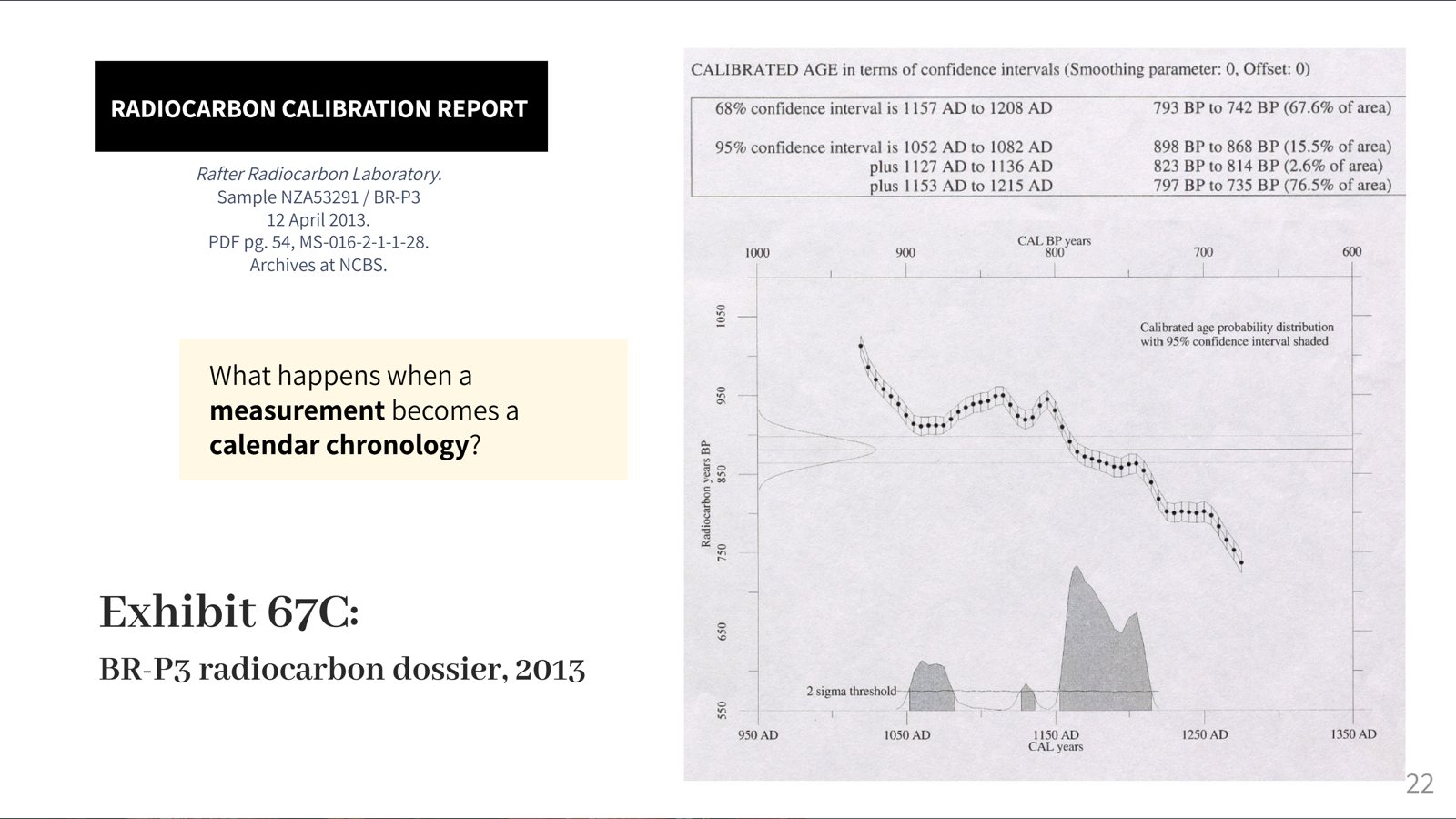
The final answer has to be calibrated. What does it mean? Radiocarbon dating gives us an estimate of the carbon content. We take another material of known age, use its carbon content to calibrate and find a comparable date at which this type of carbon content would have been formed.
So it's sort of a metric we use. Instead of using the previous 881 plus minus 17 years, we're going to calibrate that using materials of known ages. And calibration, this looks a bit intimidating even to me, but calibration just, once you're done calibrating, instead of getting another neat little single number and a single plus minus uncertainty term, it's giving us a bunch of time intervals.
It's giving us a bunch of ranges of dates. It's not giving us one single answer. It's giving us a probability distribution.
It's saying that across these three intervals is 95% of the probability, and within this interval is 68% of the probability.
Pay attention to this first time interval, 1052 AD to 1082 AD.
That is the handwritten annotation at the top of this report.
Why? Was it just a note added to make this sheet of paper more identifiable among other similar sheets of paper? Was this the answer people decided to — I think I heard something, sorry. Was this the answer the scientists decided to use once all this processing was done? By itself, we don't know. But it is definitely something to think about.
If indeed, these, instead of listing all of the ranges, or at least the ones with the highest probabilities, as the potential age, or when that sample was, when that piece of soil formed or was deposited there — if indeed the answer is chosen to be just one of these intervals using whatever logic, then we can claim that the ageing results have been compressed. One range is much easier to put into a notebook or a caption or a conclusion section, a result section of a paper, than making sure all of this is listed every single time we're referring to the sample that's been analysed.
And this introduces one more operation happening to the scientific knowledge, which is compression. Compression is allowing this sample report and its findings and the story of this sample to travel. And compression is not necessarily a bad thing, if the reasons for the compression and the justifications for the compression go along with the result, wherever the result travels.
So, because of compression, what becomes easier to communicate, and what has becomeless visible, and what consequences does that have on the final scientific claim we are testing.
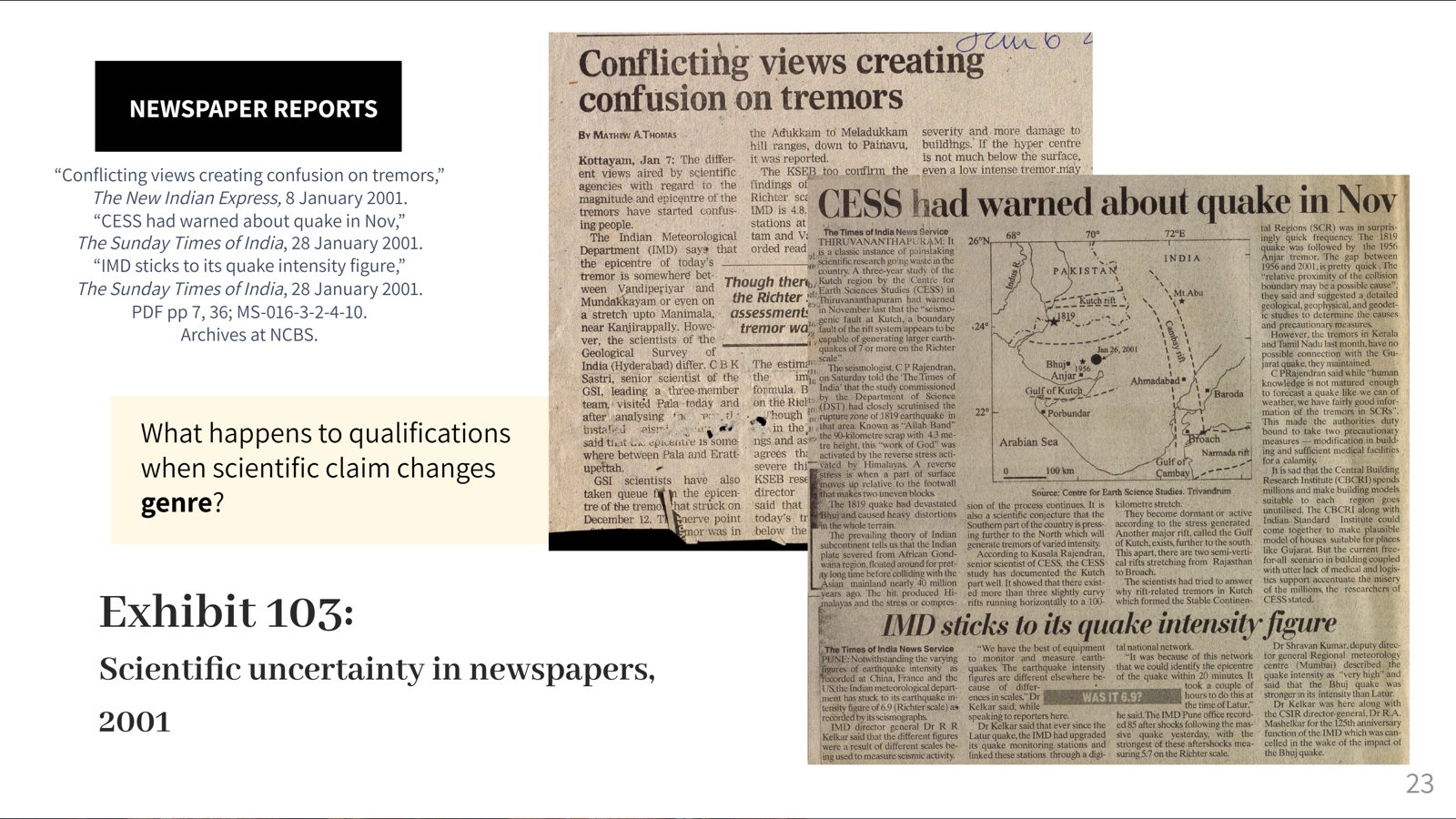
Because claims, scientific claims, do travel. They travel into schools, into universities, they travel into society through media, they travel on the internet, they travel in magazines, they travel in WhatsApp.
Here, I've grouped three newspaper reports about the Bhuj earthquake. And one headline says, and these are from the Rajendran Collection as well, one headline says, conflicting views creating confusion on tremors. The next one says, CESS, a scientific institution, had warned about quake in November. And the third headline says, IMD sticks to its quake intensity figure.
We have a declaration that there is a bunch of numbers of measurements that are having disagreements with each other. And the writer has, oh my gosh, and the writer has gone a step ahead and said, the different measurements are the cause of confusion.
But that's something that's not necessarily the obvious inference. Because numbers can differ depending on the kinds of measurements you've used. Even in something as straightforward as the magnitude of an earthquake, there's at least three different types of magnitudes with three different formulae.
And there's nothing said in this first article about what type of measurements they were and where they were sourced from, what units they had, what limitations they came with.
Inside the second article, we have a very bold headline. We have a suggestion that a scientific institution warned the government or warned the country about an impending earthquake, but nothing was done. That's the implication. But when you read the article, the attack is a lot softer. In the second article, it only says that researchers had identified seismic potential in the region. Identified seismic potential is different from we came to you and told you an earthquake was coming but you did nothing. We have some kind of an exaggeration happening. But some details have also been compressed, especially if you think about how many people glance at headlines and develop opinions about the real world.
Suddenly we're back in a situation like that in L'Aquila, Italy, where we can't predict is being turned into nothing will happen, except here they're saying something will happen/we can't predict an earthquake will happen.
None of that was actually shared by the scientists.
And finally, we have one of the authorities referred to in this article justifying the measurement they came up with. So, it's not really contributing to an active decrease in the confusion in any way. But at least this article is explaining all the uncertainty, all the qualifications, all the limitations and all the rationale built into whatever earthquake magnitude figure it had come up with.
Here [across the slide], numerical disagreement in measurements is being called confusion, and seismic potential has become they warned us but we didn't do anything. And I don't think the lesson here is that journalism is terrible. Or, science journalism in particular is terrible, because we see a lot of compression of scientific knowledge happening.
Then again, every genre of documents compresses. Scientists compress when they're turning many probability distributions into one single date range, like we saw in the research report. Institutions compress when they're turning assessments into classifications and categories for easier communication and administrative decision making. Journalists compress when they're trying to turn an argument into a headline.
The question is not does compression occur and is journalism terrible? The question is which parts of the justification have travelled with the claim, which haven't and why? What was left behind in communicating this aspect of scientific knowledge?

And then there is one final complication. Most of the exhibit examples we've seen allow time. Another sample can be collected, another measurement can be made, somebody can invent a more reliable statistical model for prediction.
But an early warning system for tsunamis and earthquakes does not have that luxury. And an example is the Indian Tsunami Early Warning System or ITEWS, which at least from this image from a report, has stations in different places to collect signals from the ocean as early as possible if there may be a tsunami or a tsunami-like disturbance approaching the mainland. And the ITEWS has tostart assessing the situation even while the earthquake or tsunami is still unfolding.
People working at these stations can notice initial signs and signals, initial changes in the wave and the oceans in terms of patterns and movement and dynamism. But they can't really wait for a clear picture, can they? Because an early warning has to be sent out to nearby locations that something is approaching you at this speed. And so, you give an initial advisory; you may even give an early warning.
But as you collect more information, that assessment and that advisory is updated. Which makes perfect sense logically, of course; that's how an early warning would work. But waiting for complete information is, from any perspective, the wrong thing to do.
Here, in this case, the epistemological standard of conveying, understanding, interpreting and making decisions based on scientific knowledge, can't just be do not act or proceed until you have 100% certainty. It is, is the evidence I have reliable enough for now, for here?
And time has entered the justification process. Information that would be grossly inadequate to create a scientific account is being used to decide whether or not an early warning has to be issued or levels of risk have to be communicated.
And I think that's an important connecting counterpoint to the idea that greater precision and greater certainty is always the right thing, no matter what.
In this case, science or engineering or applications of science and engineering don't just mean waiting until or working at the problem until all uncertainty has disappeared. Sometimes, there is no such moment that’s possible.
And uncertainty is a part of a trade-off that we're making in order to be able to take actions. The question now I find much more useful instead of is this uncertainty or not is what has been justified at this stage?
When one of these seismic stations, let's say the one in Goa here, detects information coming from the ocean that satisfies that station's criteria for warranting an early warning issue, then nobody honestly should care about the scientific uncertainty built into those numbers or the models used to estimate whether the criteria for an early warning have been met. A provisional claim can still be extremely well justified as long as, of course, there's no repercussions for issuing an early warning and then no earthquake.
We find that uncertainty by itself is not a problem, really. The problem for uncertainty comes when a claim is travelling much further than the evidence can justify.
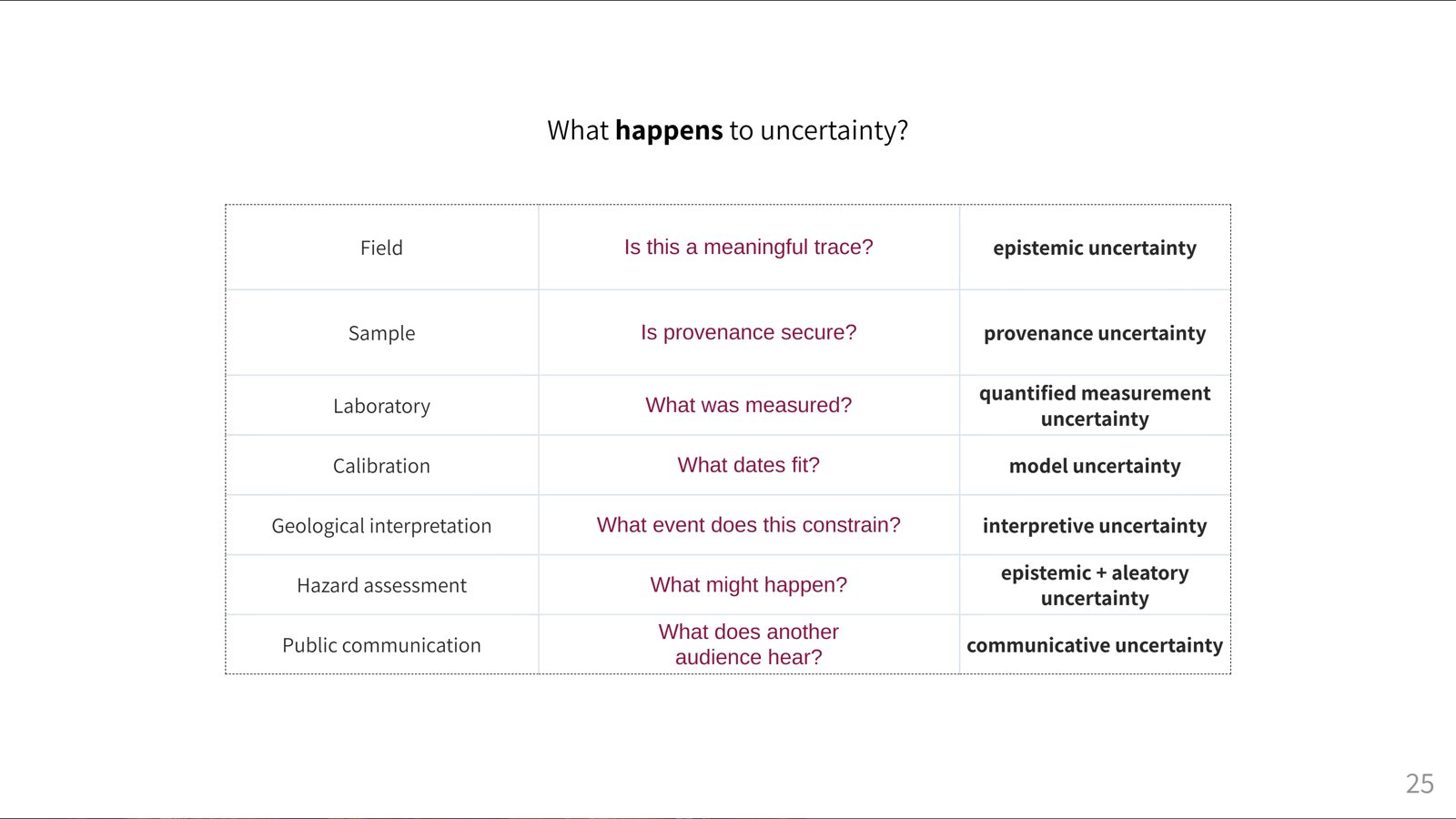
Maybe scientific knowledge from many different sources is in part an achievement of mediation, the construction of relationships between what can be encountered in the present and what can't.
And the relationship between what's possible and what's not possible works very differently if you're looking at the past and differently if you're looking at the future. Looking backward, the more you look, the further you go, the traces accumulate. You have more options for evidence, you have a greater volume of evidence, maybe better quality of evidence and you only get better at reading traces because of better instruments, better technology, more experience as time progresses.
But looking forward, there's no equivalent archive of signs and symbols and traces and proxies. There's nothing waiting for us. All we have is the information that's behind us.
And yet earthquake knowledge is precisely asked to be helpful in the forward direction. Future-facing questions have to be answered and they have to be answered reliably which can only be tested once the future has arrived and become the present. The deeper tension I have found is not that every claim made and every form scientific knowledge takes needs its justifications and transparency and limitations.
That's all well and good.
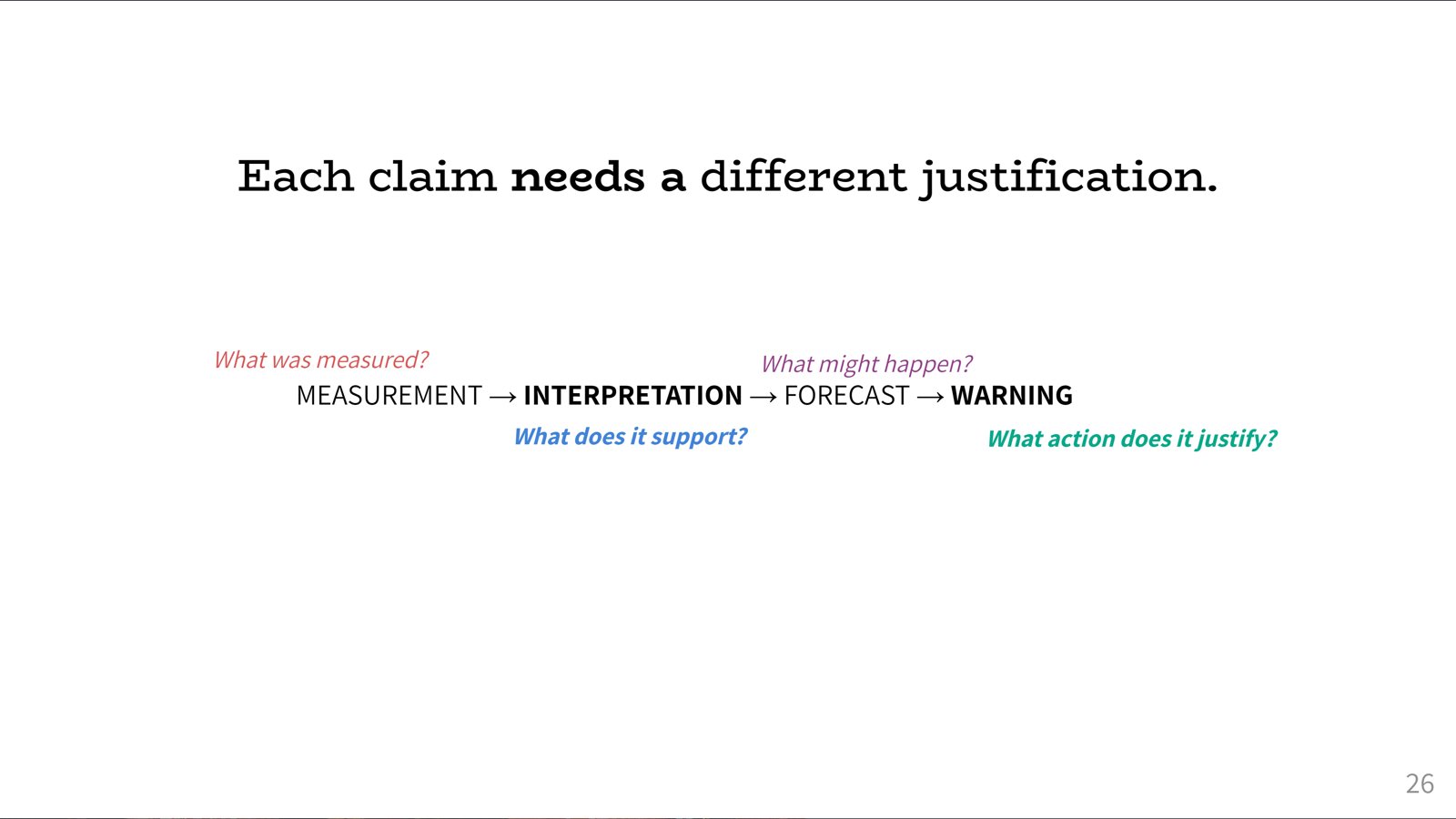
Every claim does need its own justification. But perhaps that's the philosophical meaning of the scientist is always late.
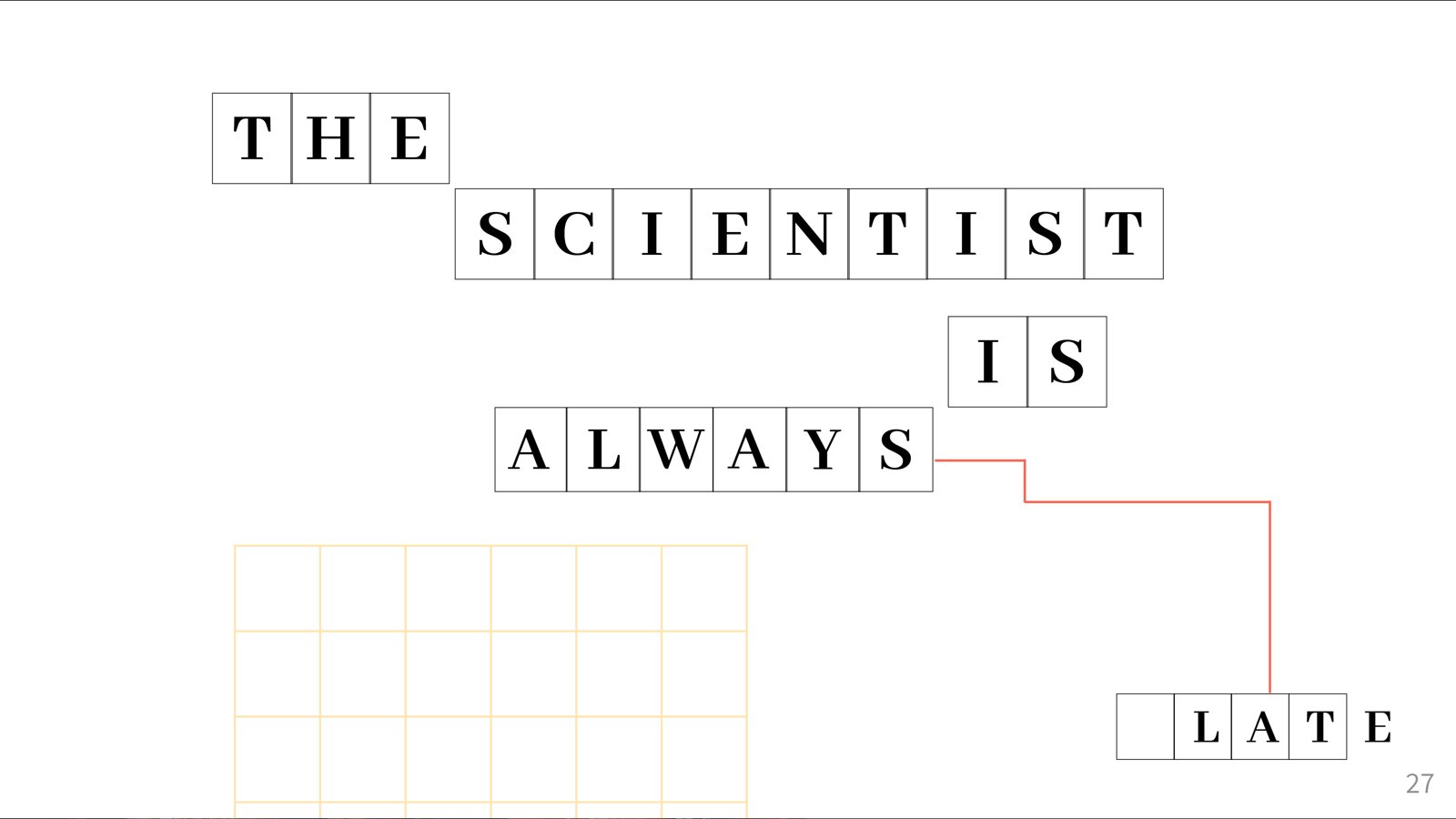
Because lateness is not a defect in science and neither is uncertainty. In many sciences like in seismology, lateness is the only condition under which scientific knowledge can be created and tested. And maybe the problem is not about making the future very precisely normal and foreseen.
Maybe the challenge for us is how to make decisions using present information and past evidence but still keeping ourselves open to the idea that the future is 100% undecided. And maybe in every science, it's really about how well you're able to answer the question of your interest using what's available. And maybe it's not about conquering the entire body of knowledge available in objective reality, assuming there is an objective reality.
So, we're always using a world that's passed by to understand ourselves now and the world that's approaching. And if you think about how the human animal perceives things, we're almost always running just a little bit behind reality, and living off of and making decisions off of perspectives, and making a lot of interesting judgements using uncertainty as sometimes an excuse, sometimes the impetus, sometimes the reason, sometimes the reason not to do something.
And I do believe that's the last note card.
We’re done. Thank you very much for listening and for being here.
[applause]
[audience interactions, including with the Rajendrans, are not yet transcribed but are available in the audio and video recordings]
THE END
C P Rajendran and Kusala Rajendran Papers; MS-016
A Report on the December 2, 1994 Wadakkancheri Earthquake, March 1995; PDF pg. 3, MS-016-2-4-3-10.
A Report on the December 2, 1994 Wadakkancheri Earthquake, March 1995; PDF pg. 26, MS-016-2-4-3-10.
INCOIS Final Review Meeting, “Reconstruction of History of Tsunami Events Occurred in the Indian Sub-continent.” 21 December 2012; PDF pg. 55, MS-016-2-1-1-28.
Hut Bay field observations presented by Kusala Rajendran. INCOIS Final ReviewMeeting, “Reconstruction of History of Tsunami Events Occurred in the Indian Sub-continent.” 21 December 2012; PDF pg. 51, MS-016-2-1-1-28.
Rafter Radiocarbon Sample BR-P3 / NZA 53291. Charcoal from a fault zone in the Himalaya. 12 April 2013; PDF p. 52, MS-016-2-1-1-28.
Rafter Radiocarbon Calibration Report. Sample BR-P3 / NZA 53291. 12 April 2013; PDF p. 54, MS-016-2-1-1-28.
“Conflicting views creating confusion on tremors,” The New Indian Express, 8 January 2001. “CESShad warned about quake in Nov,” The Sunday Times of India, 28 January 2001. “IMD sticks to its quake intensity figure,” The Sunday Times of India, 28 January 2001; PDF pp 7, 36, MS-016-3-2-4-10.
Magritte, R. (1929). The treachery of images (This is not a pipe) [Oilon canvas]. Los Angeles County Museum of Art, Los Angeles, CA, United States. https://collections.lacma.org/object/31931
Mohanakrishnan, V., Sivaraj, K. K., Jeong, H.-W., Bovay, E., Dharmalingam, B., Bixel, M. G., Dinh, V. V., Petkova, M.,Paredes Ugarte, I., Kuo, Y.-T., Gurusamy, M., Raftrey, B., Chu, N. T. L., Das, S., Rios Coronado, P. E., Stehling, M., Sävendahl, L., Chagin, A. S., Mäkinen,T., … Adams, R. H. (2024). Specialized post-arterial capillaries facilitateadult bone remodelling. Nature Cell Biology, 26(12), 2020–2034. https://doi.org/10.1038/s41556-024-01545-1.
Purkanti, R., & Thattai, M. (2015). Ancient dynamin segments capture early stages of host–mitochondrial integration. Proceedings of theNational Academy of Sciences, 112(9), 2800–2805. https://doi.org/10.1073/pnas.1407163112
Varma, A., Udupa, S., Sengupta, M., Ghosh, P. K., & Thirumalai, V.(2024). A machine-learning tool to identify bistable states from calcium imaging data. The Journal of Physiology, 602(7), 1243–1271. https://doi.org/10.1113/JP284373
Stiller, M. (2025, May 15). The conversation with statistician, Sir David Spiegelhalter. SPHERE Magazine. https://www.spherelife.com/culture/the-conversation-david-spiegelhalter
Stanford, K. (2023). Underdetermination of scientific theory. In E. N. Zalta & U. Nodelman (Eds.), The Stanfordencyclopedia of philosophy (Summer 2023 ed.). Metaphysics Research Lab,Stanford University. https://plato.stanford.edu/archives/sum2023/entries/scientific-underdetermination/plato.stanford.edu
ANI. (2026, October 4). Magnitude 3.8 earthquake hits Tripura. Deccan Chronicle. https://www.deccanchronicle.com/nation/magnitude-38-earthquake-hits-tripura-1992978
KL News Network. (2026, October 3). Earthquakestrikes Maharashtra, NCS says. Kashmir Life. https://kashmirlife.net/earthquake-strikes-maharashtra-ncs-says-454962/
Reuters. (2026, October 4). Earthquake of magnitude 5.9 strikes Indonesia’s Sumbawa region, GFZ says. The Hindu. https://www.thehindu.com/news/international/earthquake-strikes-indonesia-sumbawa-region-updates/article71542528.ece
The Hindu Bureau. (2026, July 30). Japan earthquake updates: At least 18 people dead as rescuers comb through quakerubble in southwestern Japan. The Hindu. https://www.thehindu.com/news/international/japan-earthquake-today-live-updates-seismic-activity-tsunami-warnings-on-july-28-2026-several-dead-injured/article71276753.ece
Jain, S. K., Murty, C. V. R., Chandak, N., Seeber, L., & Jain, N.K. (1994, January). The September 29, 1993, M 6.4 Killari, Maharashtra,earthquake in central India. EERI Newsletter, 28(1), 1–8. https://nicee.org/eqe-iitk/uploads/EQR_Killari.pdf
Google. (n.d.).[Google Maps]. Retrieved October 01, 2026, from https://www.google.com/maps
Live Science Staff. (2011, September 20). L’Aquila earthquake gallery: A day of destruction [Photo gallery]. Live Science. https://www.livescience.com/16131-aquila-earthquake-gallery.html
Rajendran, C. P., & Rajendran, K. (2024). The rumbling earth: The story of Indian earthquakes. Vintage Books. ISBN 9780670095612.
Bhattacharya, S. N., & Dattatrayam, R. S.(2000). Recent advances in seismic instrumentation and data interpretation in India. Current Science, 79(9), 1347–1358. https://www.jstor.org/stable/24105286
Lomnitz, C., & Nilsen-Hofseth, S. (2005). The Indian Ocean disaster: Tsunami physics and early warning dilemmas. Eos, Transactions American Geophysical Union, 86(7), 65–70. https://doi.org/10.1029/2005EO070001
Malik, J. N., Shishikura, M., Echigo, T., Ikeda, Y., Satake, K.,Kayanne, H., Sawai, Y., Murty, C. V. R., & Dikshit, O. (2011). Geologic evidence for two pre-2004 earthquakes during recent centuries near Port Blair,South Andaman Island, India. Geology, 39(6), 559–562.https://doi.org/10.1130/G31707.1
Universal Images Group Editorial. (n.d.). Mapof the Pacific Ring of Fire [Map]. Geology In. https://www.geologyin.com/2018/01/the-ring-of-fire.html
Raghukanth, S. T. G., Sreejaya, K. P., &Dhanya, J. (2022). Probabilistic seismic hazard map of India: Final report. Indian Institute of Technology Madras; National Disaster Management Authority. https://doi.org/10.5281/zenodo.6813154
Devi, E. U., Sunanda, M. V., Kumar, B. A., Kumar, Ch. P., & Kumar,T. S. (2016). Real-time earthquake monitoring at the Indian Tsunami Early Warning System for tsunami advisories in the Indian Ocean. The International Journal of Ocean and Climate Systems, 7(1), 20–26. https://doi.org/10.1177/1759313115623164